
Key Takeaways
- GSTR-9 for FY 2025-26 is due 31 December 2026. GSTR-1 and GSTR-3B for the whole year must be filed first.
- Turnover decides the form. Up to ₹2 crore: exempt. Above ₹2 crore: GSTR-9. Above ₹5 crore: GSTR-9 plus self-certified GSTR-9C.
- Claim pending ITC early. Any FY 2025-26 credit must be claimed by 30 November 2026, or before you file GSTR-9 if that is earlier.
- GSTR-9 cannot be revised. Reconcile books with GSTR-1, GSTR-3B and GSTR-2B before filing.
- Late fees run from ₹50 to ₹200 a day depending on turnover.
- There is a three-year time bar. An annual return cannot be filed more than three years after its due date.
Current to 23 October 2026. Dates, thresholds and late fees are based on the CGST Act and notifications as of this date. CBIC may extend due dates or change forms, so check the GST portal and current notifications before you file.
The GSTR-9 due date for FY 2025-26 is one part of a longer checklist. The form can only be opened once every monthly or quarterly return for the year is on file, credit claims close before the annual return does, and GSTR-9 cannot be revised after filing. That makes the preparation more important than the filing itself.
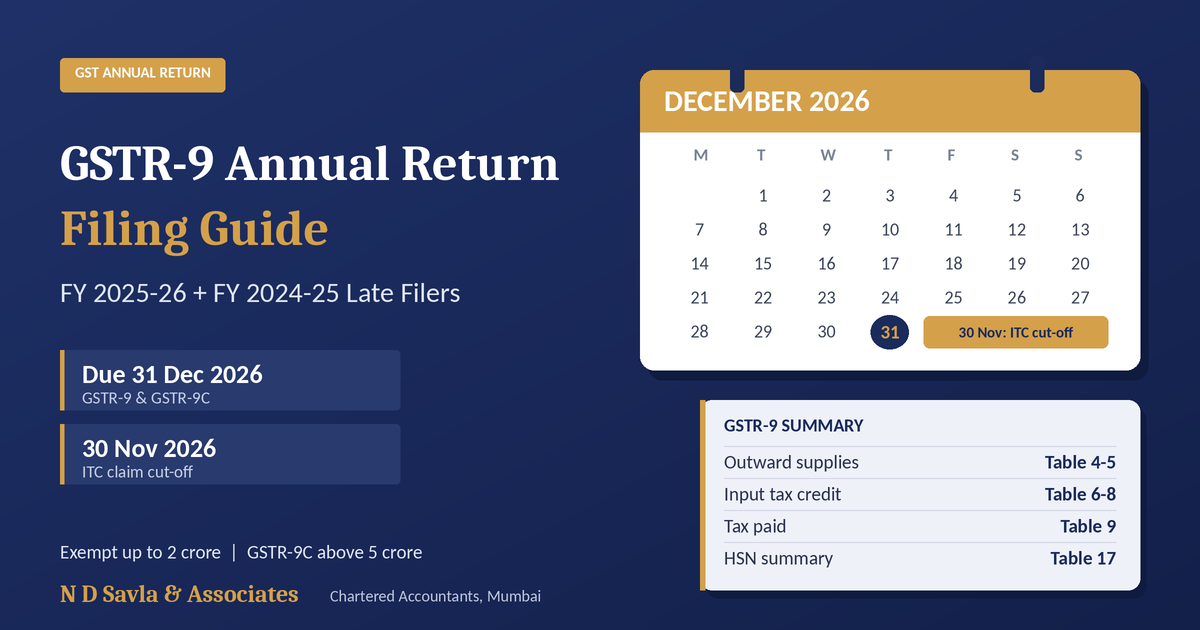
This guide sets out who must file, the key dates, what changed in the form and the rules, a preparation checklist, the portal steps and the cost of delay. It also covers what is still possible if you have not filed for FY 2024-25. Unfamiliar terms such as input tax credit and aggregate turnover are explained in our tax glossary, and our GST compliance team can handle reconciliations and the filing itself.
ApplicabilityWho Must File GSTR-9 and GSTR-9C for FY 2025-26?
| Aggregate turnover in FY 2025-26 | GSTR-9 | GSTR-9C |
|---|---|---|
| Up to ₹2 crore | Exempt (Notification No. 15/2025-Central Tax) | Not required |
| Above ₹2 crore and up to ₹5 crore | Mandatory | Not required |
| Above ₹5 crore | Mandatory | Mandatory (self-certified) |
GSTR-9 applies to regular taxpayers. Composition taxpayers file GSTR-4, and input service distributors, casual and non-resident taxable persons and TDS or TCS deductors are outside GSTR-9. Aggregate turnover is computed on a PAN basis across all registrations, but GSTR-9 is filed separately for each GSTIN. If you also run a company and want the annual GST filing managed alongside the books, see our accounting and tax compliance service.
The CalendarWhat Are the Key Dates?
| Date | What happens | Why it matters |
|---|---|---|
| 8 October 2026 | GSTR-9 and GSTR-9C for FY 2025-26 enabled on the portal | Filing window is open |
| 30 November 2026 | Last date to claim FY 2025-26 ITC (or annual return filing date, if earlier) | Unclaimed credit after this is lost |
| 31 December 2026 | Due date for GSTR-9 and GSTR-9C, FY 2025-26 | Late fees apply from 1 January 2027 |
| 31 December 2028 | Last date to file GSTR-9 for FY 2024-25 | Three-year time bar |
| 31 December 2029 | Last date to file GSTR-9 for FY 2025-26 | Three-year time bar |
GSTN's advisory of 13 October 2026 reminds taxpayers that the GSTR-9/9C tile appears only once all GSTR-1 and GSTR-3B returns for FY 2025-26 have been filed. Add these dates to your tracker or use our Compliance Calendar.
What's NewWhat Changed in GSTR-9 Recently?
Table changes introduced for FY 2024-25
GSTN's FAQ on the FY 2024-25 changes, as summarised in professional commentary, describes these updates, which carry the form closer to GSTR-2B and GSTR-3B data:
- Table 6A1: input tax credit of the previous year claimed in the current year (other than reclaims under Rules 37 and 37A).
- Table 8A: auto-populated from GSTR-2B for the year's invoices, including those filed up to October of the following year.
- Table 8C: current-year ITC claimed in the following year; reclaimed ITC goes only in Table 13.
- Table 8H1: a new row for imports of the year whose ITC is claimed in the following year.
- GSTR-1A and GSTR-3B: GSTR-1A data now flows into Tables 4 and 5, and net tax liability is taken from GSTR-3B Table 6.1.
- HSN reporting: a new Excel download supports Table 17, and the 65% concessional-rate column was removed from Tables 17 and 18.
Check the FY 2025-26 form and any new GSTN advisory before filing, as table instructions can change year to year.
The September 2025 GST rate changes
From 22 September 2025, most goods and services moved to a two-rate structure of 5% and 18%, with a 40% rate for selected luxury and sin goods, and the 12% and 28% slabs were largely removed. FY 2025-26 is therefore the first annual return that spans both structures. Check rate-wise and HSN-wise outward supplies, credit notes on pre-change supplies and ITC on purchases around the change date before filing.
The ₹2 crore exemption
Notification No. 15/2025-Central Tax, issued in September 2025, exempts registered persons with aggregate turnover up to ₹2 crore from filing GSTR-9 from FY 2024-25 onwards. The exemption covers the annual return only; all periodic returns must still be filed.
How Should You Prepare Before Filing?
Because GSTR-9 cannot be revised, most of the work happens before you open the form. Work through this checklist first:
- Confirm every return is filed. All GSTR-1 and GSTR-3B returns for the year must be on file; the annual return tile will not appear otherwise.
- Reconcile outward supplies. Match the books with GSTR-1, GSTR-1A and GSTR-3B, including credit and debit notes and amendments.
- Reconcile ITC. Match ITC claimed in GSTR-3B with GSTR-2B (Table 8A) and the purchase register, and identify credit to be claimed by 30 November 2026 and credit to be reversed.
- Review HSN and rates. Check HSN-wise summaries and the split between pre- and post-22 September 2025 rates.
- Pay any short-paid tax. Identify it and pay it through DRC-03 with interest before filing.
- Prepare for GSTR-9C. For turnover above ₹5 crore, reconcile audited financial statements with GSTR-9.
- Keep working papers. Differences may later be queried through scrutiny or notices.
How Do You File GSTR-9 on the GST Portal?
Open the Annual Return
Log in to the GST portal, go to Returns, then Annual Return, and select FY 2025-26.
Tip: If the tile is missing, check for unfiled GSTR-1 or GSTR-3B.
Answer the Questionnaire
Indicate whether a nil return applies.
Tip: A nil return is available only where there were no supplies, ITC or liability.
Download System Summaries
Download the system-computed GSTR-9 summary, the Table 8A details and the GSTR-1/3B summaries.
Tip: Compare them with your reconciliation.
Fill or Edit the Tables
Review auto-populated values and complete Tables 4 to 18.
Tip: Use the HSN Excel download for Table 17.
Compute Liabilities and Late Fee
Let the portal compute tax payable and any late fee.
Tip: Pay any additional liability through DRC-03.
Preview and File
Download the draft, check it, then file with DSC or EVC.
Tip: Filing is final; there is no revision.
File GSTR-9C if Applicable
Upload the reconciliation statement for turnover above ₹5 crore.
Tip: It is self-certified; file it after GSTR-9.
What Happens If You File Late or Not at All?
| Turnover in the State or UT | Late fee per day (CGST + SGST) | Maximum |
|---|---|---|
| Up to ₹5 crore | ₹50 (₹25 + ₹25) | 0.04% of turnover (0.02% + 0.02%) |
| Above ₹5 crore up to ₹20 crore | ₹100 (₹50 + ₹50) | 0.04% of turnover (0.02% + 0.02%) |
| Above ₹20 crore | ₹200 (₹100 + ₹100) | 0.5% of turnover (0.25% + 0.25%) |
These rates apply from FY 2022-23 under Notification No. 07/2023-Central Tax. The portal calculates the late fee automatically.
Separately, interest at 18% a year applies to any tax found short-paid, and non-filing increases the chance of scrutiny and notices. Because of the three-year time bar introduced by Finance Act, 2023, an annual return that is not filed within three years of its due date can no longer be filed at all.
Earlier YearHaven't Filed GSTR-9 for FY 2024-25? What You Can Still Do
The due date for FY 2024-25 was 31 December 2025; no extension had been announced as of mid-December 2025. If your aggregate turnover for FY 2024-25 exceeded ₹2 crore and you have not filed, you can still file until 31 December 2028, with the late fee calculated automatically by the portal from 1 January 2026 to the date of filing.
The FY 2024-25 form includes the table changes described above. Reconcile the year's returns first, pay any short-paid tax through DRC-03 with interest, and file GSTR-9C as well if turnover exceeded ₹5 crore. If you have received a notice for the year, take advice before filing.
Plan AheadWhich Dates Should You Watch Next?
Keep an eye on CBIC extension notifications in December and on GSTN advisories about table changes for FY 2025-26. Income tax deadlines run in parallel, so see our guide to the ITR due dates for FY 2025-26 as well.
| Date | What falls due |
|---|---|
| 30 November 2026 | Last FY 2025-26 ITC claims |
| 31 December 2026 | GSTR-9 and GSTR-9C for FY 2025-26 |
| December 2026 | Watch for any CBIC extension notification and GSTN advisories |
| 31 December 2028 | Time bar for any unfiled FY 2024-25 return |
What Are the Most Asked Questions About GSTR-9?
What is the due date for GSTR-9 for FY 2025-26?
31 December 2026, unless the government extends it. The GST portal enabled GSTR-9 and GSTR-9C for FY 2025-26 on 8 October 2026, and GSTN has advised that all GSTR-1 and GSTR-3B returns for the year must be filed before the annual return tile becomes available.
Who must file GSTR-9?
Regular taxpayers whose aggregate turnover for the year exceeds ₹2 crore. Notification No. 15/2025-Central Tax exempts registered persons with aggregate turnover up to ₹2 crore from filing GSTR-9 from FY 2024-25 onwards. Composition taxpayers, input service distributors, casual taxable persons, non-resident taxable persons and TDS or TCS deductors file other returns instead.
Who must file GSTR-9C?
Taxpayers with aggregate turnover above ₹5 crore must file GSTR-9C, a reconciliation statement between the audited financial statements and GSTR-9, along with their annual return. Since FY 2020-21 it is self-certified by the taxpayer rather than certified by a Chartered Accountant or Cost Accountant, although many businesses still have it prepared or reviewed by one.
Is GSTR-9 mandatory if my turnover is below ₹2 crore?
No. Under Notification No. 15/2025-Central Tax, registered persons with aggregate turnover up to ₹2 crore in a financial year are exempt from filing GSTR-9 from FY 2024-25 onwards. You must still file all monthly or quarterly returns, and you should keep books that reconcile with them in case of scrutiny.
What is the last date to claim input tax credit for FY 2025-26?
Under section 16(4) of the CGST Act, ITC for invoices of FY 2025-26 can be claimed up to 30 November 2026 or the date of filing the annual return, whichever is earlier. If you file GSTR-9 before 30 November, the window closes on the filing date, so claim pending credit in GSTR-3B before filing the annual return.
Can GSTR-9 be revised after filing?
No. There is no facility to revise GSTR-9 once filed. Reconcile books, GSTR-1, GSTR-3B and GSTR-2B before filing. If you find additional tax payable while preparing the return, pay it through Form DRC-03 with interest; excess ITC or unreported liabilities discovered later must be corrected through the payment and adjustment routes available, not by revising GSTR-9.
What is the late fee for filing GSTR-9 late?
Under Notification No. 07/2023-Central Tax, applicable from FY 2022-23, the late fee is ₹50 a day (CGST and SGST combined) for turnover up to ₹5 crore and ₹100 a day for turnover from ₹5 crore to ₹20 crore, each capped at 0.04% of turnover in the State, and ₹200 a day for turnover above ₹20 crore, capped at 0.5%. The portal calculates it automatically.
Is there a time limit for filing an old GSTR-9?
Yes. Finance Act, 2023 introduced a three-year limit: a registered person cannot file an annual return after three years from its due date. For FY 2024-25, whose due date was 31 December 2025, the last date is therefore 31 December 2028. For FY 2025-26 it will be 31 December 2029.
What changed in GSTR-9 from FY 2024-25?
GSTN's FAQ for FY 2024-25 describes a new Table 6A1 for previous-year ITC claimed in the current year, Table 8A auto-populated from GSTR-2B, Table 8C for current-year ITC claimed in the next year, a new Table 8H1 for imports claimed in the next year, GSTR-1A data flowing into Tables 4 and 5, and an Excel download for HSN reporting in Table 17. Check whether the FY 2025-26 form adds further changes.
How do the GST rate changes of September 2025 affect GSTR-9 for FY 2025-26?
From 22 September 2025, most goods and services moved to a 5% or 18% rate, with a 40% rate for selected luxury and sin goods, and the 12% and 28% slabs were largely removed. FY 2025-26 therefore spans two rate structures, so HSN-wise and rate-wise outward supplies, credit notes and ITC need careful checking before filing.
Related Guides and Services
- Deadline Alert: ITR Filing Due Dates for FY 2025-26 (AY 2026-27): every income tax return date, the extended audit-case deadline and late fees.
- GST and indirect tax services: GST compliance, reconciliations and annual return filing.
- Accounting and tax compliance: year-round compliance for companies and individuals.
- Income tax audit: audit support and report filing for companies and businesses.
- Compliance Calendar, tax calculators and the Tax Glossary: quick references for dates, computations and terms.
Questions on Your GSTR-9 Filing?
N D Savla & Associates, Chartered Accountants, advises on GST compliance including annual returns and reconciliations. For questions, contact the firm using the details below.
Suite No.102, L1, Ashok Premises, Nicholas Road, Andheri East, Mumbai - 400069
Contact the Firm →This article is for general information only and is not professional advice or a solicitation of work.