
Key Takeaways
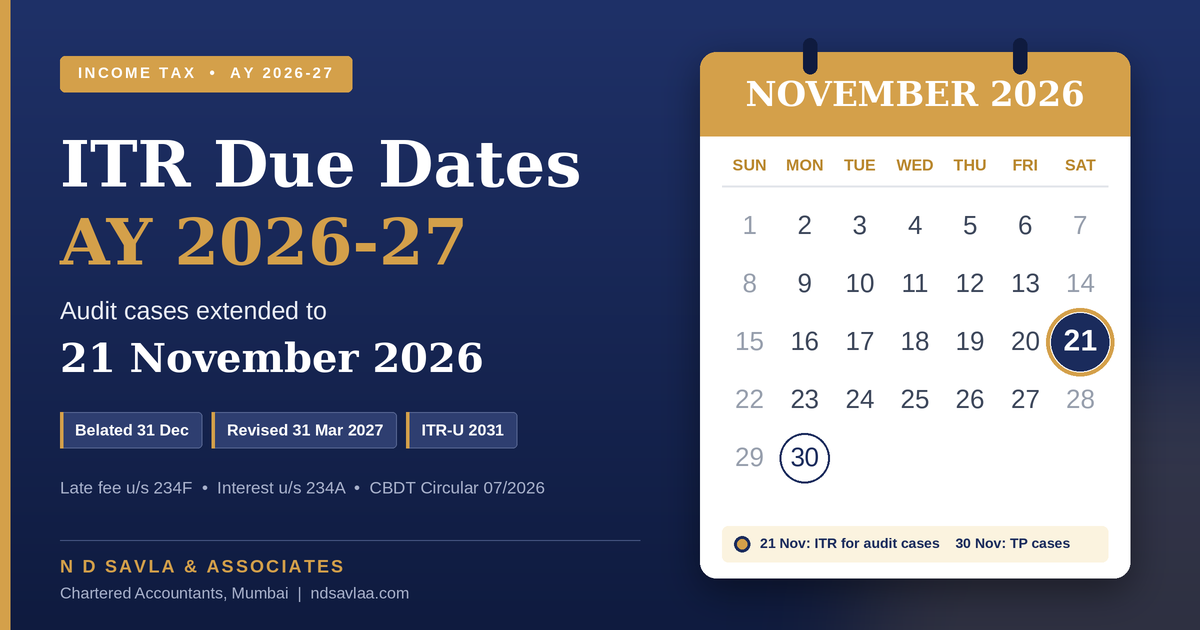
- Audit cases: ITR due 21 November 2026. It was extended from 31 October. The tax audit report was due 21 October 2026, extended from 30 September.
- Transfer pricing cases are not covered. For assessees who must furnish a section 92E report, the ITR is due 30 November 2026.
- Non-audit business and professional taxpayers now file by 31 August. ITR-1 and ITR-2 filers stayed at 31 July.
- Belated returns are open until 31 December 2026. Revised returns are open until 31 March 2027, with a fee after 31 December 2026.
- An updated return (ITR-U) can be filed until 31 March 2031. It comes with an additional tax of 25% to 70%.
- Late fee under section 234F is up to ₹5,000. Interest under section 234A runs on unpaid tax, and the extension circular does not mention interest.
Current to 22 October 2026. CBDT has issued extensions close to the deadline in each of the last two years, so check the incometax.gov.in due-date page before you file and treat the dates below as live information.
The ITR due date AY 2026-27 is not one date. It depends on who you are and what you earn, and 2026 changed the calendar in three ways. Budget 2026 gave non-audit business taxpayers an extra month, CBDT pushed the audit-case dates back by three weeks, and the time to revise a return grew from nine months to twelve.
This guide puts every deadline in one place and shows which one applies to you. It explains what each missed date costs, and what is still possible for anyone who has already slipped past a deadline, including taxpayers who missed the FY 2024-25 dates. If you are unsure what a belated, revised or updated return means in practice, our tax glossary explains each term.
The CalendarWhat Are the ITR Due Dates for FY 2025-26 (AY 2026-27)?
The ITR due date for FY 2025-26 (AY 2026-27) was 31 July 2026 for individuals and HUFs without business income, and 31 August 2026 for non-audit business and professional taxpayers. Both have passed. The live deadlines are 21 November 2026 for companies and others whose accounts must be audited, and 30 November 2026 for transfer pricing cases.
| Taxpayer or filing | Typical form | Due date | Status on 22 Oct 2026 |
|---|---|---|---|
| Individuals and HUFs without business or professional income | ITR-1, ITR-2 | 31 July 2026 | Passed |
| Non-audit business or profession (incl. presumptive) and partners of non-audit firms | ITR-3, ITR-4 | 31 August 2026 | Passed |
| Tax audit report and other audit reports | Form 3CA/3CB-3CD, 10B, 10BB | 21 October 2026 (extended from 30 September) | Passed |
| Companies, assessees requiring audit, partners of audited firms (section 92E not applicable) | ITR-3, ITR-5, ITR-6, ITR-7 | 21 November 2026 (extended from 31 October) | Upcoming |
| Assessees required to furnish a transfer pricing report (section 92E) | ITR-3, ITR-5, ITR-6 | 30 November 2026 | Upcoming |
| Belated return, section 139(4) | Applicable ITR | 31 December 2026 | Open |
| Revised return, section 139(5) | Applicable ITR | 31 March 2027 (fee after 31 December 2026) | Open |
| Updated return (ITR-U), section 139(8A) | ITR-U | 31 March 2031 | Open, with additional tax |
Forms are indicative; the correct ITR depends on the nature of income and the type of taxpayer. Dates reflect the Income-tax Act, 1961 as amended, Budget 2026 changes and CBDT Circular No. 07/2026. Check the Income Tax Department's site for any further extension.
If you are not sure which form fits your income, our ITR form selector guide walks through an eight-step method, and the new ITR forms for AY 2026-27 guide explains what changed this year. Businesses and professionals who need to file for the 31 August or 21 November dates can see our business tax filing service, and cases that need a tax audit can start there too.
The ExtensionWhat Did CBDT Circular No. 07/2026 Change?
On 28 September 2026 the Central Board of Direct Taxes issued Circular No. 07/2026 (F. No. 225/128/2026/ITA-II) under section 119 of the Income-tax Act, 1961, read with section 536 of the Income-tax Act, 2025. It made two changes for AY 2026-27:
- Tax audit report: the "specified date" under clause (ii) of the Explanation to section 44AB was extended to 21 October 2026, from 30 September 2026. Professional summaries apply the same date to other audit reports such as Forms 10B and 10BB.
- Return of income: the due date under Explanation 2 to section 139(1) for companies, assessees whose accounts must be audited and partners of audited firms (and their spouses where section 5A applies), where section 92E does not apply, was extended from 31 October 2026 to 21 November 2026.
The Income Tax Department's due-date page confirms the 21 November 2026 date for these assessees. The circular does not extend the date for transfer pricing cases, so those remain at 30 November 2026.
Interest is not mentioned. The circular says nothing about interest under section 234A. Until CBDT clarifies, pay any self-assessment tax as early as possible and do not wait for the extended filing date.
What Changed in Budget 2026 for ITR Deadlines?
Budget 2026, presented on 1 February 2026, changed three things that decide when a return can be filed, revised or reported under the old and new Acts.
A new 31 August due date for non-audit business taxpayers
Budget 2026 staggered the filing calendar. Non-audit taxpayers with business or professional income, and partners of non-audit firms, now file by 31 August instead of 31 July, starting with AY 2026-27. Salaried individuals and others filing ITR-1 or ITR-2 kept the 31 July date.
A longer window to revise a return
The time to file a revised return under section 139(5) was extended from nine months to twelve months from the end of the financial year, so a return for FY 2025-26 can be revised until 31 March 2027. Revisions after the nine-month point (31 December 2026) attract a fee, reported in professional commentary as ₹1,000 where total income is up to ₹5 lakh and ₹5,000 otherwise. The belated-return deadline under section 139(4) remains 31 December 2026.
The Income-tax Act, 2025
The Income-tax Act, 2025 took effect on 1 April 2026 for tax year 2026-27 onwards. Returns for FY 2025-26 are still filed under the Income-tax Act, 1961, with transitional provisions in the 2025 Act. The new Act will govern returns from the next cycle.
What Happens If You Miss the ITR Deadline?
Missing the due date brings a late fee, interest on unpaid tax and, for some taxpayers, a loss of carry-forward rights. The table sets out the main consequences.
| Consequence | Provision | What it means |
|---|---|---|
| Late fee | Section 234F | ₹5,000 if total income exceeds ₹5 lakh; ₹1,000 if it is ₹5 lakh or less; nil if income does not exceed the basic exemption limit |
| Interest on unpaid tax | Section 234A | 1% a month or part of a month on tax due, from the due date until the return is filed |
| Loss carry-forward | Section 80 read with section 139(3) | Business and capital losses cannot be carried forward if the return is filed late (house property loss and unabsorbed depreciation are exceptions) |
| Old-regime option for business income | Section 115BAC | Taxpayers with business income who want the old regime must file Form 10-IEA by the section 139(1) due date |
| Tax audit report not furnished | Section 271B | Penalty of up to 0.5% of turnover or gross receipts, capped at ₹1.5 lakh, unless reasonable cause is shown |
These are the main consequences under the Income-tax Act, 1961. Whether a particular penalty applies depends on the facts, so take advice before filing late.
Earlier YearMissed the FY 2024-25 (AY 2025-26) Deadlines? What You Can Still Do
The AY 2025-26 deadlines have all passed. The original 31 July 2025 due date for non-audit taxpayers was extended to 15 September and then to 16 September 2025. The audit-case date was extended to 10 December 2025, with tax audit reports due by 10 November 2025, and belated and revised returns closed on 31 December 2025.
The remaining route is usually an updated return (ITR-U) under section 139(8A), available until 31 March 2030 for AY 2025-26. You pay the tax and interest due plus an additional tax under section 140B, and the rate rises the later you file:
| ITR-U filed within | Additional tax (section 140B) | For AY 2025-26, by |
|---|---|---|
| 12 months of the end of the assessment year | 25% of tax and interest | 31 March 2027 |
| 24 months | 50% | 31 March 2028 |
| 36 months | 60% | 31 March 2029 |
| 48 months | 70% | 31 March 2030 |
The same slabs apply to AY 2026-27 from 31 March 2027 onwards, with the final date falling on 31 March 2031.
An updated return cannot be filed to declare a loss, reduce tax or claim or increase a refund, and it is not available in some situations, such as where proceedings have started. If you have received a notice, take advice before filing.
Before You FileWhat Should You Check Before Filing?
A short pre-filing routine helps you avoid common refund delays and notices. Use the seven checks below, whatever your due date. You can also run your numbers through our Income Tax Calculator first.
Reconcile Income and Tax Credits
Reconcile income and tax credits with Form 26AS and the Annual Information Statement (AIS), and correct mismatches before filing. Our guide shows how to read and reconcile your AIS before filing ITR, and dividend income with its TDS is covered in our guide to Section 194 TDS on dividends.
Choose the Tax Regime Deliberately
The new regime is the default. Business taxpayers opting for the old regime must file Form 10-IEA by the due date.
Pay Self-Assessment Tax Early
Pay any self-assessment tax before filing, and early, to limit interest under section 234A.
Confirm the Correct ITR Form
Confirm the correct ITR form for your income and status. The ITR form selector guide and the new ITR forms for AY 2026-27 guide help you choose.
Pre-Validate the Bank Account
Pre-validate the bank account for refunds on the e-filing portal.
Verify the Return
Verify the return, electronically or by post, within the time allowed after filing. An unverified return is treated as not filed. Once it is verified, keep a certified copy of the filed return for your records.
For Audit Cases, Get the Report Accepted First
Make sure the audit report is uploaded and accepted before filing the return. Our tax audit page covers audit support.
Which Dates Should You Watch Next?
Four dates matter over the coming months. Keep an eye on CBDT announcements, as extensions have been issued close to the deadline in each of the last two years.
| Date | What falls due |
|---|---|
| 21 November 2026 | ITR for audit cases |
| 30 November 2026 | ITR for transfer pricing cases |
| 31 December 2026 | Belated returns and fee-free revisions |
| 31 March 2027 | Final date for revised returns |
Add these to your own tracker or use our Compliance Calendar, and use the Advance Tax Calculator to plan your next advance tax instalment. For companies and investors who want help throughout the year, our accounting and tax compliance team can manage the calendar.
Frequently Asked QuestionsWhat Are the Most Asked Questions About ITR Due Dates for AY 2026-27?
What is the last date to file ITR for FY 2025-26 (AY 2026-27)?
It depends on the taxpayer. The due date was 31 July 2026 for individuals and HUFs without business income, and 31 August 2026 for non-audit business and professional taxpayers. For companies and others whose accounts must be audited, CBDT Circular No. 07/2026 extended the date to 21 November 2026. Transfer pricing cases have until 30 November 2026.
Has the ITR due date for audit cases been extended for AY 2026-27?
Yes. CBDT Circular No. 07/2026, dated 28 September 2026, extended the return due date for companies, assessees whose accounts must be audited and partners of audited firms (where section 92E does not apply) from 31 October 2026 to 21 November 2026. It also extended the tax audit report date from 30 September 2026 to 21 October 2026.
Why is the due date for ITR-3 and ITR-4 31 August this year?
Budget 2026 moved the due date for non-audit business and professional taxpayers, and partners of non-audit firms, from 31 July to 31 August, effective for AY 2026-27. Individuals filing ITR-1 or ITR-2 kept the 31 July date. The change staggers the filing load and gives business taxpayers more time to close their accounts.
Can I still file my ITR for AY 2026-27 if I missed the deadline?
Yes, as a belated return under section 139(4), up to 31 December 2026, unless the Assessing Officer has completed an assessment earlier. A late fee under section 234F of ₹5,000 applies (₹1,000 if total income is up to ₹5 lakh), interest under section 234A runs on unpaid tax, and some losses cannot be carried forward when the return is late.
What is the last date to revise an ITR for AY 2026-27?
Budget 2026 extended the time to file a revised return under section 139(5) from nine to twelve months from the end of the financial year, which for FY 2025-26 means 31 March 2027. A revision filed after 31 December 2026 attracts a fee, reported as ₹1,000 where total income is up to ₹5 lakh and ₹5,000 otherwise. Check the final provision with your adviser.
What is an updated return (ITR-U), and when can it be filed?
An updated return under section 139(8A) lets you report missed income after the belated and revised windows close, by paying the tax, interest and an additional tax under section 140B. Since Finance Act 2025 it can be filed up to 48 months from the end of the assessment year, so until 31 March 2031 for AY 2026-27. The additional tax rises from 25% to 70% the later you file.
What is the late fee for filing ITR after the due date?
Under section 234F, the fee is ₹5,000 if total income exceeds ₹5 lakh and ₹1,000 if it is ₹5 lakh or less. No fee applies if total income does not exceed the basic exemption limit. Interest under section 234A at 1% a month or part of a month also runs on any unpaid tax from the due date until the return is filed.
Does the extension to 21 November 2026 also cover interest?
Circular No. 07/2026 extends the due date but says nothing about interest under section 234A. Unless the CBDT clarifies otherwise, pay any self-assessment tax as early as possible to limit interest exposure, rather than waiting for the extended filing date.
I missed the FY 2024-25 (AY 2025-26) deadlines. What can I do now?
The due dates for AY 2025-26 have passed: 16 September 2025 for non-audit cases, 10 December 2025 for audit cases, and 31 December 2025 for belated and revised returns. The remaining option is usually an updated return (ITR-U), which can be filed until 31 March 2030 with additional tax. ITR-U cannot be used to claim a refund, declare a loss or reduce your tax.
Do the new Income-tax Act, 2025 rules apply to my AY 2026-27 return?
The Income-tax Act, 2025 took effect on 1 April 2026 for tax year 2026-27 onwards. Income for FY 2025-26 (AY 2026-27) is still governed by the Income-tax Act, 1961, which is why CBDT Circular No. 07/2026 was issued under section 119 of the 1961 Act, read with section 536 of the 2025 Act. Check which provisions apply to your situation with a Chartered Accountant.
Related Guides and Services
- Which ITR Form Should You File for AY 2026–27? Complete Selector Guide: an eight-step method to match your income to the right form.
- New ITR Forms for AY 2026–27 (FY 2025–26): Complete Guide to Changes, Slabs & ITR-B: what changed in the forms you will file this year.
- How to Read & Reconcile Your AIS Before Filing ITR for AY 2026–27: match income and tax credits before you file.
- Section 194 TDS on Dividends FY 2025-26: Rate, Threshold, Exemptions & Compliance Guide: rate, limit, Form 15G/15H and how to claim the credit.
- Income tax audit: audit support and report filing for companies and businesses.
- Business tax filing: returns for business and professional taxpayers.
- Income tax return true copy: certified copies of your filed return.
- Accounting and tax compliance: year-round compliance for companies and individuals.
- Compliance Calendar, tax calculators and the Tax Glossary: quick references for dates, computations and terms.
Questions on Your ITR Due Date?
N D Savla & Associates, Chartered Accountants, advises on income tax return filing, tax audits and related compliance. For questions on your filing, contact the firm using the details below.
Suite No.102, L1, Ashok Premises, Nicholas Road, Andheri East, Mumbai - 400069
Contact the Firm →This article is for general information only and is not professional advice or a solicitation of work.