
Key Takeaways
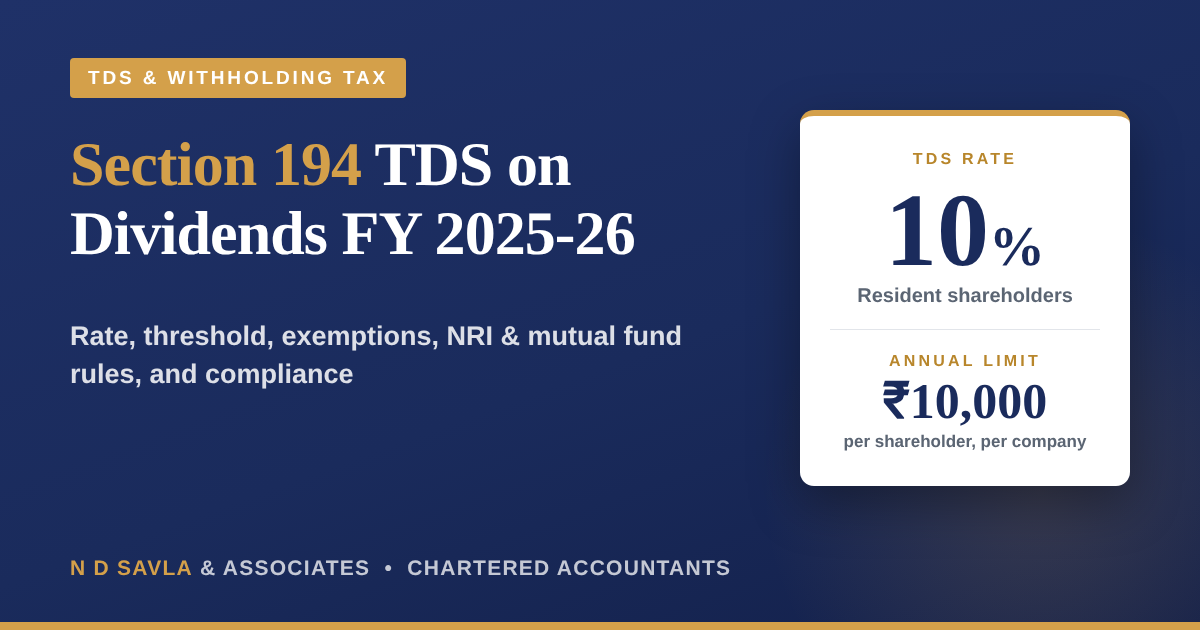
- The rate is 10% for residents. Section 194 applies to equity and preference share dividends of every domestic company, listed or unlisted.
- The limit is ₹10,000 per shareholder, per company, per year. It was ₹5,000 until FY 2024-25. Once crossed, TDS is deducted on the whole dividend, not only the excess.
- A missing PAN means 20% under section 206AA. The higher rates under sections 206AB and 206CCA were withdrawn from 1 April 2025.
- Form 15G, Form 15H or a section 197 certificate can stop the deduction. A declaration covers one financial year only.
- NRIs and mutual funds follow other sections. Non-residents fall under section 195 and Form 27Q, and mutual fund dividends under section 194K.
- Deposit by the 7th of the next month. Late action brings interest, a section 234E fee and a section 271H penalty.
Section 194 TDS on dividends FY 2025-26 raises more questions than the two headline figures answer. What happens if a shareholder holds shares jointly, has no PAN, is a senior citizen with low income, lives abroad, or holds mutual fund units rather than shares? How does the company report the deduction, and how does the investor get credit for it?
This guide takes these questions one at a time. It is written for finance teams that must deduct and deposit the tax, and for investors who want to understand the amount that reaches their bank account. We also explain the penalties for getting it wrong and show a compliance routine that works for companies of any size.
The BasicsSection 194 TDS on Dividends FY 2025-26: What Is It in Simple Terms?
Section 194 is the rule that obliges a domestic company to deduct income tax from any dividend it pays to a resident shareholder and to deposit that tax with the government. The shareholder gets the dividend net of tax and later claims credit for the amount deducted.
Think of it as tax collected at the source rather than at the end of the year. The dividend is income of the shareholder, taxable at their normal slab rate, and the company simply collects a first instalment on the government's behalf. The rule covers dividend on both equity and preference shares and applies to every kind of domestic company, listed or unlisted, large or small. In a family-owned private company, a director who pays a dividend to relatives must follow it just as a listed company does.
The shareholder's income tax return then shows the full dividend as income and the tax deducted as a credit. If the shareholder's final tax is lower, the difference is refunded, and if it is higher, the shareholder pays the balance. For companies that want help running this process, our TDS return filing team handles deduction, deposit and returns.
Rate & LimitHow Much TDS Is Deducted on Dividends in FY 2025-26?
The TDS rate on dividends paid to resident shareholders in FY 2025-26 is 10%, and no tax is deducted where the total dividend paid to a shareholder in the financial year is ₹10,000 or less, provided it is paid by account payee cheque or an electronic mode.
A simple example shows how the limit works. Suppose a company pays ₹5 per share as dividend. A shareholder with 2,000 shares receives exactly ₹10,000, which is within the limit, so there is no TDS. A shareholder with 2,001 shares receives ₹10,005, which crosses the limit, and the company must deduct 10% on the whole ₹10,005, which is about ₹1,001, not merely on the ₹5 above the limit.
The limit is tested per shareholder, per company and per financial year, and it takes in every dividend paid in that year, interim as well as final. The previous limit of ₹5,000 was doubled from 1 April 2025.
| Recipient | Section | TDS rate | Limit or condition |
|---|---|---|---|
| Resident shareholder | 194 | 10% | No TDS up to ₹10,000 in the year |
| Resident without PAN | 206AA | 20% | Applies when PAN is not furnished |
| Non-resident shareholder | 195 | Usually 20% plus surcharge and cess | Treaty rate possible; reported in Form 27Q |
| Mutual fund unit holder | 194K | 10% | ₹10,000 from 1 April 2025; the fund house deducts |
Rates are for dividends paid in FY 2025-26. Confirm the position on the date of payment before you deduct.
If a shareholder has not given a PAN, the rate rises to 20% under section 206AA. Earlier, shareholders who had not filed returns in the past two years faced higher rates under sections 206AB and 206CCA, but those provisions were withdrawn from 1 April 2025, so the company need not run that check for FY 2025-26 payments. Companies should still keep PAN data complete, since the cost of a missing PAN falls on the shareholder and the mismatch lands on the company's return.
ExemptionsWho Is Not Subject to TDS on Dividends?
TDS on dividends is not deducted when the dividend is within the ₹10,000 limit, when the recipient is one of the insurers named in the section, or when a valid Form 15G, Form 15H or lower deduction certificate is in force. The dividend remains taxable in the recipient's hands in every case.
The section carves out Life Insurance Corporation of India, General Insurance Corporation of India and its subsidiaries, and other insurers for shares they own or in which they hold the full beneficial interest.
For individuals, section 197A provides a self-declaration route. A resident individual or HUF whose total income, including the dividend, will not be taxable can submit Form 15G, and a resident who is 60 or older can submit Form 15H, and both need a PAN. The company or its registrar must hold the declaration before it pays the dividend, must keep it for the prescribed period, and must report it in its return. A shareholder who expects the actual tax to be below 10%, for example because of carried-forward losses, can apply to the assessing officer under section 197 for a certificate that sets a lower or nil rate.
Note. A declaration in Form 15G or Form 15H covers only one financial year. Shareholders who rely on it should submit a fresh one each year before the dividend is paid, because a declaration filed after the deduction cannot reverse it. The tax would then have to be claimed as a refund in the return.
How Does TDS Work for NRIs, Mutual Fund Units and Buy-Backs?
For NRIs, mutual fund units and buy-backs, different provisions apply, and applying plain Section 194 to them is a frequent source of error. Each follows its own section, rate and return form.
NRI and Other Non-Resident Shareholders
Dividends paid to non-resident shareholders attract tax under section 195, usually at 20% plus surcharge and cess, though a tax treaty may reduce the rate if the shareholder provides a tax residency certificate and Form 10F. The deduction is reported in Form 27Q, not Form 26Q, and the remittance abroad may need Form 15CA and Form 15CB. NRIs earning Indian dividends can find more in our accounting and tax compliance support.
Mutual Fund Dividends
Mutual fund dividends are covered by section 194K, which has the same 10% rate and the same ₹10,000 limit from 1 April 2025, and it is the fund house that deducts.
Buy-Backs
Buy-backs by companies from 1 October 2024 have been taxed as deemed dividend in the shareholder's hands, and tax on such payments to residents is reported to be deductible under Section 194 for FY 2025-26, though the position is expected to change from FY 2026-27 under the Income-tax Act, 2025, so verify before payment.
How Should a Company Handle Dividend TDS Compliance Step by Step?
A company should treat dividend TDS as a fixed routine that starts when the dividend is declared and ends when certificates reach shareholders. The seven steps below describe a workable sequence for Section 194 TDS on dividends FY 2025-26.
Freeze the Shareholder Data Before Payment
Take a record date list and check PAN, residential status, joint holding details and bank mandates. Correct errors before the payment run, not after it.
Mark Shareholders Who Have Declarations or Certificates
Identify those who have given Form 15G, Form 15H or a lower deduction certificate, and the insurers and other categories outside the section. Keep the documents in an auditable folder.
Apply the Annual Limit Per Shareholder
Aggregate all dividends paid to each shareholder in the year and compare the total with ₹10,000. Where an interim dividend has already been paid, include it when testing the final dividend.
Deduct and Pay the Net Amount
Deduct 10% from residents who cross the limit, 20% where PAN is missing, and the applicable rate from non-residents. Credit only the net amount and preserve the calculation sheet.
Deposit the Tax With the Government
Deposit by the 7th of the following month, with 30 April as the due date for deductions made in March. Link every challan to the shareholders it covers so that the return can be tied back.
File the Quarterly Return and Issue Certificates
File Form 26Q for residents and Form 27Q for non-residents by 31 July, 31 October, 31 January and 31 May, then issue Form 16A within 15 days of the return due date.
Reconcile and Respond to Defaults
Check the department's records for mismatches, file a correction statement where needed, and clear any default notice promptly. Our accounting and tax compliance and bookkeeping services support this.
The consequences of getting the routine wrong are specific. Interest runs at 1% per month for late deduction and 1.5% per month for late deposit, a fee of ₹200 a day applies under section 234E for a late return, up to the amount of the tax, and a penalty of ₹10,000 to ₹1 lakh can follow under section 271H.
| Default | Consequence |
|---|---|
| Late deduction | Interest at 1% per month |
| Late deposit | Interest at 1.5% per month |
| Late TDS return | Fee of ₹200 a day under section 234E, up to the amount of the tax |
| Return defaults | Penalty of ₹10,000 to ₹1 lakh under section 271H |
| Tax deducted but not deposited | Higher interest and, in the worst cases, prosecution of the responsible persons |
Companies that need a controlled year-end review can add support from CFO services and an annual income tax audit.
Important. Tax deducted from shareholders but not deposited with the government is treated as a serious default. It attracts higher interest and, in the worst cases, prosecution of the persons responsible, so the deposit should be the first item on the payment calendar and not the last.
How Can Shareholders Verify and Claim Their TDS Credit?
Shareholders can verify credit by checking Form 26AS and the Annual Information Statement for the company's deduction, and claim it by reporting the full dividend as income and the TDS as tax already paid in the return.
Start by listing every dividend you received in FY 2025-26 from bank statements, broker statements and the registrar's communications. Then compare it with the dividend and TDS entries in Form 26AS and the AIS. Our guide on how to read and reconcile your AIS before filing ITR shows how. If a company has deducted tax but not reported it, the credit will not show, and you should request the company or registrar to correct its return.
Report the dividend under income from other sources, deduct only interest expense that was incurred to earn it, up to 20% of the dividend, and claim the TDS credit as it appears in the statements. A resident whose income is below the taxable limit and who had tax deducted despite being eligible for Form 15G gets a refund on filing. To choose the right return form, see the new ITR forms for AY 2026-27 guide.
Investors with large portfolios and both dividend and trading income should see our income tax return true copy and business tax filing pages for support.
BackgroundWhy Has the Dividend TDS Regime Been Reshaped Over the Years?
The dividend TDS regime was reshaped because India moved between taxing the company that distributes profit and taxing the shareholder who receives it, and Section 194 is the working part of the system now in place.
1961 to 2020: From Shareholder Tax to Distribution Tax and Back
In the earliest design of the 1961 Act, dividends were income of the shareholder. The Finance Act, 1997 shifted the burden to the company through dividend distribution tax, leaving the dividend exempt in the shareholder's hands. In 2002 that was reversed and dividends were taxed again in the hands of recipients, and in 2003 distribution tax returned, staying in place until 2020 with several changes of rate.
2020 Onwards: Section 194 as the Main Collection Tool
The Finance Act, 2020 abolished distribution tax for dividends paid from 1 April 2020, and Section 194 became the main collection tool. From 14 May 2020 to 31 March 2021, a lower rate of 7.5% applied as COVID relief, after which the 10% rate returned. Budget 2025 then raised the limit to ₹10,000 and withdrew the special higher rates for non-filers.
The Income-tax Act, 2025 starts from 1 April 2026, but FY 2025-26 dividends are governed by the 1961 Act. Current forms and rules are published on the official portal at incometax.gov.in.
Section 194 TDS on Dividends FY 2025-26: Frequently Asked Questions
What is the TDS rate on dividend in FY 2025-26?
For resident shareholders, the TDS rate on dividend under Section 194 is 10% in FY 2025-26, provided the dividend exceeds ₹10,000 in the year. If PAN is not furnished, the rate is 20%. For non-residents, the deduction is made under section 195, generally at 20% plus surcharge and cess, unless a treaty gives a lower rate.
What is the TDS limit on dividend income?
Tax is not deducted if the dividend paid to a shareholder by a company in a financial year is ₹10,000 or less and is paid by account payee cheque or an electronic mode. The limit was ₹5,000 until FY 2024-25 and was raised from 1 April 2025. Once the total goes above ₹10,000, tax is deducted on the entire amount.
Can I submit Form 15G or Form 15H for dividend income?
Yes, if you are a resident whose total income, including the dividend, is below the taxable limit. Individuals and HUFs use Form 15G, and senior citizens aged 60 or more use Form 15H. You must quote your PAN and submit a fresh declaration each financial year, before the dividend is paid.
Is TDS deducted on mutual fund dividends?
Yes. Dividend from mutual fund units is covered by section 194K, which provides for 10% TDS with a ₹10,000 limit from 1 April 2025. The mutual fund deducts the tax, and the investor claims credit in the return.
How can I see the TDS deducted on my dividends?
Download Form 26AS and the Annual Information Statement from the e-filing portal and look for the company's entries under dividend and TDS. The company should also issue Form 16A. If an entry is missing, ask the company or its registrar to correct its TDS return so that the credit shows.
What happens if a company does not deduct TDS on dividends?
The company can face interest for late deduction at 1% per month and for late deposit at 1.5% per month, a late return fee of ₹200 per day, and a penalty of ₹10,000 to ₹1 lakh. Tax deducted but not deposited can also lead to prosecution of the responsible persons.
Related Guides and Services
- New ITR Forms for AY 2026–27 (FY 2025–26): Complete Guide to Changes, Slabs & ITR-B: pick the right return form before you claim dividend TDS credit.
- How to Read & Reconcile Your AIS Before Filing ITR for AY 2026–27: match dividend and TDS entries before you file.
- Which ITR Form Should You File for AY 2026–27? Complete Selector Guide: an eight-step method to match your income to the right form.
- TDS return filing: deduction, deposit, Form 26Q and Form 27Q returns, and Form 16A.
- Accounting and tax compliance: year-round compliance for companies and NRI shareholders.
- Bookkeeping: clean records that tie challans and returns together.
- CFO services: controlled year-end reviews for finance teams.
- Income tax audit: annual audit support for companies.
- Income tax return true copy: certified copies of your filed return.
- Business tax filing: returns for investors with dividend and trading income.
Need Help With TDS on Dividends?
Correct handling of Section 194 TDS on dividends FY 2025-26 protects companies from interest and penalties and protects investors from lost credits. N D Savla & Associates helps companies with TDS computation, quarterly returns and certificates, and helps shareholders with return filing and refunds. Reach us through our contact page.
Suite No.102, L1, Ashok Premises, Nicholas Road, Andheri East, Mumbai - 400069
Talk to a CA →