Key Takeaways
- Scope: one firm handles bookkeeping, reconciliations, GST and TDS returns, financial statements and annual ROC filings under a written engagement.
- GST: GSTR-1 is due on the 11th and GSTR-3B on the 20th; credit is available only for invoices that appear in GSTR-2B, so monthly matching matters.
- ROC: AOC-4 is due within 30 days of the AGM and MGT-7 within 60 days; DIR-3 KYC is due by 30 September each year.
- Cost: typically ₹5,000 to ₹25,000 a month for a small business package, against ₹3 lakh to ₹6 lakh a year for an in-house accountant in Mumbai.
- Responsibility: outsourcing moves the work, not the responsibility; directors still sign the accounts and returns.
What Are Outsourced Accounting Services and What Do They Cover?
What are outsourced accounting services? They are the day-to-day accounting, tax and statutory work of a business handed to an external firm under a written engagement, so the business no longer has to employ and supervise its own accounts team. A typical package covers recording transactions, bank and ledger reconciliations, GST and TDS returns, financial statements, and the annual filings required under the Companies Act, 2013.
Scope varies by business size. A trading company with a few hundred invoices a month usually needs outsourced bookkeeping services in India plus monthly GST filing, while a growing private limited company adds payroll, MIS reporting and ROC compliance. Firms that offer accounting and tax compliance services usually bundle these items into one monthly fee, which makes budgeting easier than paying for each filing separately.
Outsourced accounting services for small business typically start with bookkeeping and GST, then add ROC and income tax work as the company grows. Because the same team records the transaction, files the return and prepares the financial statements, every number has one owner. Pairing monthly bookkeeping services with return filing is the simplest way to achieve that. Outsourced bookkeeping services in India also give a clean base for every later filing.
| Area | What the firm typically handles | Frequency |
|---|---|---|
| Bookkeeping | Sales, purchase, expense and bank entries; ledger and bank reconciliations | Monthly |
| GST | GSTR-2B matching, GSTR-1 and GSTR-3B filing, annual return GSTR-9 | Monthly and annual |
| TDS and payroll | TDS payment and returns, salary processing, PF, ESI and professional tax | Monthly and quarterly |
| ROC and company law | AOC-4, MGT-7, ADT-1, DIR-3 KYC, DPT-3, MSME-1, LLP Forms 8 and 11 | Annual and half-yearly |
| Financial statements and MIS | Trial balance, balance sheet, profit and loss, management reports | Monthly and annual |
| Income tax | Tax computation, advance tax, return filing | Quarterly and annual |
Typical scope of an outsourced accounting engagement. The exact list depends on the written engagement with the firm.
GST ComplianceHow Do Outsourced Accounting Services Streamline GST Compliance?
Outsourced accounting services streamline GST compliance by recording every sale and purchase correctly at source, running GSTR-2B reconciliation every month and filing GSTR-1 and GSTR-3B before the due dates. Outsourced accounting services for GST compliance therefore replace last-minute data gathering with a steady monthly routine.
For regular taxpayers, GSTR-1 is due on the 11th and GSTR-3B on the 20th of the following month. Tax paid late carries interest at 18 per cent per annum under Section 50 of the CGST Act, 2017, and each late return adds a daily late fee. A firm that owns the calendar files before the date rather than on it, which leaves room to fix errors. Outsourced accounting services make this timing routine, and GST return filing outsourcing is as much about timing as about preparation.
Input tax credit is where the difference shows most. Under Section 16(2)(aa) of the CGST Act, 2017, credit is available only for invoices that appear in the recipient’s GSTR-2B, so every supplier invoice must be matched. A firm doing GSTR-2B reconciliation every month flags missing invoices while the supplier can still correct them, and it tracks the time limit in Section 16(4), which falls on 30 November following the end of the financial year or the date of the annual return, whichever is earlier. This input tax credit reconciliation protects working capital that would otherwise stay locked in disputes.
GST return filing outsourcing also helps at year end. The annual return in Form GSTR-9 must agree with the books, the e-invoice data and the financial statements, and a team that kept the books all year reconciles those sources without reopening old months. Our GSTR-9 annual return filing guide covers who files and the steps involved. Businesses with aggregate turnover above ₹5 crore must also issue e-invoices and furnish the reconciliation statement in GSTR-9C, and the same team can connect e-invoicing to the accounting software.
ROC ComplianceHow Do Outsourced Accounting Services Simplify ROC Compliance for Companies and LLPs?
Outsourced accounting services simplify ROC compliance by producing audit-ready financial statements on time and by tracking every MCA form that depends on the annual general meeting. Outsourced ROC compliance works because most ROC forms rest on finalised accounts, so the team that maintains the books can file the forms without waiting for data from another vendor.
Outsourced accounting services for ROC compliance follow the annual cycle of a private limited company. The company holds its annual general meeting within six months of the financial year end, files financial statements in Form AOC-4 within 30 days of the meeting and the annual return in Form MGT-7 within 60 days, files Form ADT-1 for the auditor within 15 days, and completes director KYC in Form DIR-3 KYC by 30 September each year. It also files Form DPT-3 for outstanding loans and Form MSME-1 for payments to micro and small suppliers outstanding beyond 45 days.
An LLP follows a lighter cycle: Form 11 is due by 30 May and Form 8 by 30 October under the Limited Liability Partnership Act, 2008. The Companies Act, 2013 also sets standards for the books themselves. Section 128 requires accounts on the accrual basis with double entry, electronic books must be backed up on servers located in India, accounting software must keep an audit trail from 1 April 2023, and records must be retained for eight years. Outsourced ROC compliance through outsourced accounting services meets these requirements because the firm already uses compliant software, so the company builds no system of its own.
| Compliance task | Typical due date | Law or form |
|---|---|---|
| GSTR-1 | 11th of the next month | CGST Act, 2017 |
| GSTR-3B | 20th of the next month | CGST Act, 2017 |
| TDS payment | 7th of the next month | Income Tax Act, 1961 |
| GSTR-9 annual return | 31 December after the financial year | CGST Act, 2017 |
| DIR-3 KYC | 30 September | Companies Act, 2013 |
| AOC-4 | 30 days from the AGM | Section 137 |
| MGT-7 | 60 days from the AGM | Section 92 |
| ADT-1 | 15 days from appointment | Section 139 |
| LLP Form 8 / Form 11 | 30 October / 30 May | LLP Act, 2008 |
Track these dates month by month in our Compliance Calendar.
Important. Missing a ROC deadline adds an additional fee of ₹100 per day that keeps accruing until the form is filed, and a director who skips DIR-3 KYC has the DIN deactivated and must pay ₹5,000 to reactivate it. Late GST payment carries interest at 18 per cent per annum. A compliance calendar owned by one team, as in outsourced ROC compliance, prevents all three.
How Does One Set of Books Keep GST, ROC and Income Tax in Sync?
One set of books keeps GST, ROC and income tax in sync because every authority reads its numbers from the same ledgers: turnover in GSTR-1, revenue in the financial statements filed with the ROC, and income in the return filed with the Income Tax Department. When different people prepare each one, small gaps appear, and the department’s data matching finds them. Outsourced accounting services avoid this by keeping a single ledger.
Mismatches lead to notices. GST turnover that differs from the income tax return, or reverse charge tax that never reached the books, raises questions from the GST officer or the Assessing Officer. Outsourced accounting services for GST compliance remove the root cause by reconciling GST turnover with the books every quarter, running input tax credit reconciliation every month and matching the return before it is filed.
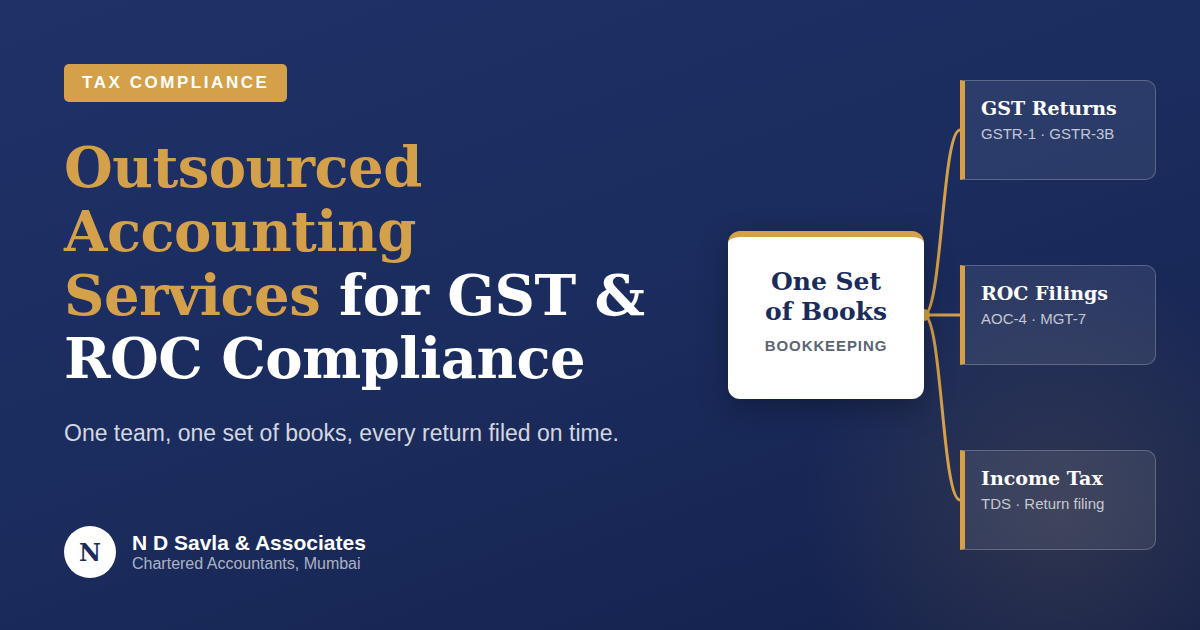
The same team can then file TDS returns for deductions on salaries and professional fees, and prepare the business tax filing once the books are closed. Each filing reuses reconciled data, so the work is done once and checked once. This is one of the quieter benefits of outsourcing accounting.
BenefitsWhat Are the Benefits of Outsourced Accounting Services for Small Business?
The main benefits of outsourced accounting services for small business are accuracy, timely filings, lower cost, access to qualified Chartered Accountants and better management information. The benefits of outsourcing accounting compound over time, because every month of clean books makes the next return quicker to prepare.
Accuracy and timeliness come from process, including input tax credit reconciliation every month. A firm works to a calendar, reviews each return before filing, and does not depend on one employee being present. Cost is the second gain. The cost of outsourced accounting services in India scales with the volume of work, and there is no salary, PF, ESI, software licence or leave cover to carry.
Information is the third benefit of outsourced accounting services. Monthly reports from MIS and budgeting services show margins, receivables and GST liability, so owners act while a problem is small. Where payroll is part of the package, payroll management makes sure PF, ESI, professional tax and TDS on salary reach the right authorities on time.
Access to expertise is the fourth. A small company rarely employs someone who knows Section 16 credit rules, ROC form sequencing and TDS sections together, but a CA firm applies that knowledge across every client. That is why outsourced accounting services for ROC compliance are popular with young private limited companies. Scale is the fifth: the team grows with the business, from one GSTIN to several states, without a hiring cycle.
Note. Outsourcing moves the work, not the responsibility. Directors still sign the accounts and the returns, so ask for monthly review calls, retain admin access to your GST and MCA portals, and keep a copy of your books.
Is In-House Accounting or Outsourced Accounting Cheaper for an Indian Business?
Outsourced accounting services are usually cheaper than an in-house accountant for most small and mid-sized businesses, because a firm spreads its team across clients while an employee costs the same in a slow month as in a busy one. The in-house accounting vs outsourced accounting decision comes down to volume, risk and the cost of replacing a person who resigns.
| Factor | In-house accountant | Outsourced firm |
|---|---|---|
| Typical cost | ₹3 lakh to ₹6 lakh a year in Mumbai, plus software and PF or ESI | ₹5,000 to ₹25,000 a month for a small business package |
| Leave or resignation | Work stops until a replacement is trained | Another team member continues the file |
| Expertise | One person’s knowledge | CA review across GST, ROC and tax |
| Compliance calendar | Depends on one person remembering | Owned and tracked by the firm |
| Software and audit trail | Company buys and maintains | Usually included in the fee |
| Scaling | New hire for each new entity | Scope added to the engagement |
The cost of outsourced accounting services in India depends on transaction volume, the number of GST registrations and entities, the condition of existing records and the mix of services. The benefits of outsourcing accounting grow when scope is defined and priced clearly, and in-house accounting vs outsourced accounting is not an all-or-nothing choice, since some companies keep a junior accountant and outsource review and filing. Businesses that outgrow a monthly accounting package can add CFO services for budgeting, cash-flow planning and fundraising support. The figures above are indicative market ranges, not the rate card of any one firm.
Choosing a FirmHow to Choose an Outsourced Accounting Firm Step by Step?
How to choose an outsourced accounting firm is a six-step exercise: define the work, check credentials, test the systems, ask for a compliance calendar, compare fixed-fee proposals and start with a trial period, once you have weighed in-house accounting vs outsourced accounting for your volume.
Define the Scope and Volume
List every task you want outsourced and note your monthly invoice count, number of GST registrations, employees and entities. A firm can quote accurately only when it sees these numbers.
Check Credentials
Confirm the ICAI membership number and firm registration number, and check that certificates carry a UDIN. Ask which partner reviews your file.
Test Software, Security and Audit Trail
Ask which accounting software the firm uses, where backups are stored, who has access to your data and whether the software keeps an audit trail as the Companies (Accounts) Rules, 2014 require.
Ask for a Compliance Calendar and Service Levels
A good firm shares a dated calendar of GST, TDS and ROC filings, names your point of contact and states how quickly it answers queries and notices.
Compare Fixed-Fee Proposals and Exclusions
Put proposals side by side and check what each leaves out, such as notice replies, revised returns, GST audit support and data cleanup of old books.
Start with a Review Period
Sign an engagement letter with a three-month review point. Renew only if deadlines were met and reconciliations were delivered without reminders.
How Has Accounting and Compliance Outsourcing Evolved in India?
Outsourced accounting services in India have moved from clerks keeping ledgers in the office before 1991 to cloud-based teams filing returns on portals today, because each new tax and company law reform made filing more frequent and more data-driven.
Before 1991, most businesses kept handwritten ledgers under the Companies Act, 1956 and the Income Tax Act, 1961, with a clerk or munim keeping the books and a Chartered Accountant visiting once a year for the audit and the tax return. Compliance was annual and paper-based, so there was little reason to outsource.
Liberalisation changed the pattern. Accounting software spread through the 1990s, service tax arrived in 1994, VAT replaced sales tax in most states from 2005, and the MCA21 programme moved company filings online in 2006. Firms began to offer accounting and filing as a continuing service. The present phase follows the Companies Act, 2013 and the GST regime from 1 July 2017, which brought monthly returns, input tax matching, e-invoicing and mandatory audit trails in accounting software. Details of company law filings and forms are available on the Ministry of Corporate Affairs website.
Frequently Asked QuestionsFrequently Asked Questions About Outsourced Accounting Services
What are outsourced accounting services?
Outsourced accounting services are the bookkeeping, tax and statutory work of a business handed to an external firm under a written engagement. A typical package covers outsourced bookkeeping services in India, reconciliations, GST and TDS returns, financial statements, payroll and annual ROC filings. The business keeps ownership of its decisions and records, while the firm runs the compliance calendar and files each return on time.
How much do outsourced accounting services cost in India?
The cost of outsourced accounting services in India typically runs ₹5,000 to ₹25,000 per month for a small business that needs bookkeeping, GST and TDS together, and more as transaction volume and entities increase. GST return filing outsourcing is typically priced at ₹1,000 to ₹3,000 per month on its own, and annual ROC compliance is usually quoted separately at ₹10,000 to ₹30,000 for a private limited company. These are indicative market ranges, exclusive of GST at 18 per cent, and a written fixed-fee proposal removes surprises.
Is it safe to outsource accounting to a CA firm?
Yes, when the engagement is documented. Chartered Accountants are bound by ICAI confidentiality rules, and a written engagement letter should add a non-disclosure clause, defined access rights and a clear exit process. Ask where the data is stored, whether the software keeps an audit trail as required under the Companies (Accounts) Rules, 2014, and how backups are taken. Keep a copy of your books and portal credentials in your own control.
Can outsourced accounting services handle both GST and ROC filings?
Yes. Outsourced accounting services for GST compliance and outsourced accounting services for ROC compliance can sit with one firm, which maintains the books, handles GSTR-2B reconciliation, files GSTR-1, GSTR-3B and GSTR-9, prepares financial statements and files ROC forms such as AOC-4, MGT-7, ADT-1 and DIR-3 KYC. Using one team for both is the main advantage, because GST turnover, financial statements and ROC filings all come from the same ledgers and stay consistent.
Who is responsible for compliance errors when accounting is outsourced?
The company and its directors remain legally responsible for compliance, because the Companies Act, 2013 requires directors to confirm that proper systems exist to ensure compliance with applicable laws. The outsourced firm is accountable to the company through the engagement letter. Choose a firm that agrees to defined turnaround times, reviews its own work and replies to notices on the same file.
How to choose an outsourced accounting firm for a small company?
How to choose an outsourced accounting firm comes down to credentials, systems and clarity. Confirm the firm’s ICAI registration, ask for a sample compliance calendar, check the accounting software and backup practice, and compare fixed-fee proposals for what they exclude, such as notice replies and revised returns. Ask who reviews your file and how quickly queries and notices are answered. Start with a three-month review period before committing to a full year.
Related Guides and Services
- Accounting and tax compliance: year-round bookkeeping, GST, TDS and ROC support on one calendar.
- Complete Guide to GST Compliance for Manpower Supply Contractors in Maharashtra: rate, reverse charge, government contracts, GST TDS and returns.
- GSTR-9 Annual Return Filing Guide for FY 2025-26: who files, the ₹2 crore exemption, GSTR-9C, late fees and filing steps.
- Deadline Alert: ITR Filing Due Dates for FY 2025-26 (AY 2026-27): every income tax return date, the extended audit-case deadline and late fees.
- Bookkeeping services, payroll management and MIS and budgeting services: the monthly base of an outsourced engagement.
- GST and indirect tax services, TDS return filing and business tax filing: returns filed from the same reconciled books.
- Compliance Calendar, tax calculators and the Tax Glossary: quick references for dates, computations and terms.
Need Professional Help with Outsourced Accounting Services?
N D Savla & Associates, a Chartered Accountant firm at Ashok Premises, Nicholas Road, Andheri East, Mumbai, runs bookkeeping, GST, TDS and ROC compliance on one calendar, and shares a written fixed-fee proposal after a free first consultation. You can also contact the firm using the details below.
Suite No.102, L1, Ashok Premises, Nicholas Road, Andheri East, Mumbai - 400069
Contact the Firm →This article is for general information only and is not professional advice or a solicitation of work.