The Digital Compliance Stack for Startups: What to Ask Your Chartered Accountant
The Digital Compliance Stack for Startups: What to Ask Your Chartered Accountant
A startup’s compliance in India now runs on a stack of digital systems, and the law sets rules for several of them. Before choosing or reviewing any Chartered Accountant, founders should understand five layers: books, GST, company law, income tax and data protection. This guide from N D Savla & Associates, Chartered Accountants, Mumbai, explains each layer and the questions to ask any adviser. It is based on the law and published sources as of 5 November 2026. For the credential checks that come first, see our guide on how to choose the right CA for your startup.
Key Takeaways
- Books: company books must be in software with an audit trail that cannot be disabled, and a daily backup in India.
- GST: e-invoicing, 30-day reporting and IMS make clean, timely data essential for input tax credit.
- Income tax: the Income-tax Act, 2025 means software, payroll and TDS settings must be updated.
- Data: DPDP duties extend to data shared with service providers, including accountants.
- Ask: how any CA handles tools, access, security, deadlines and reporting.
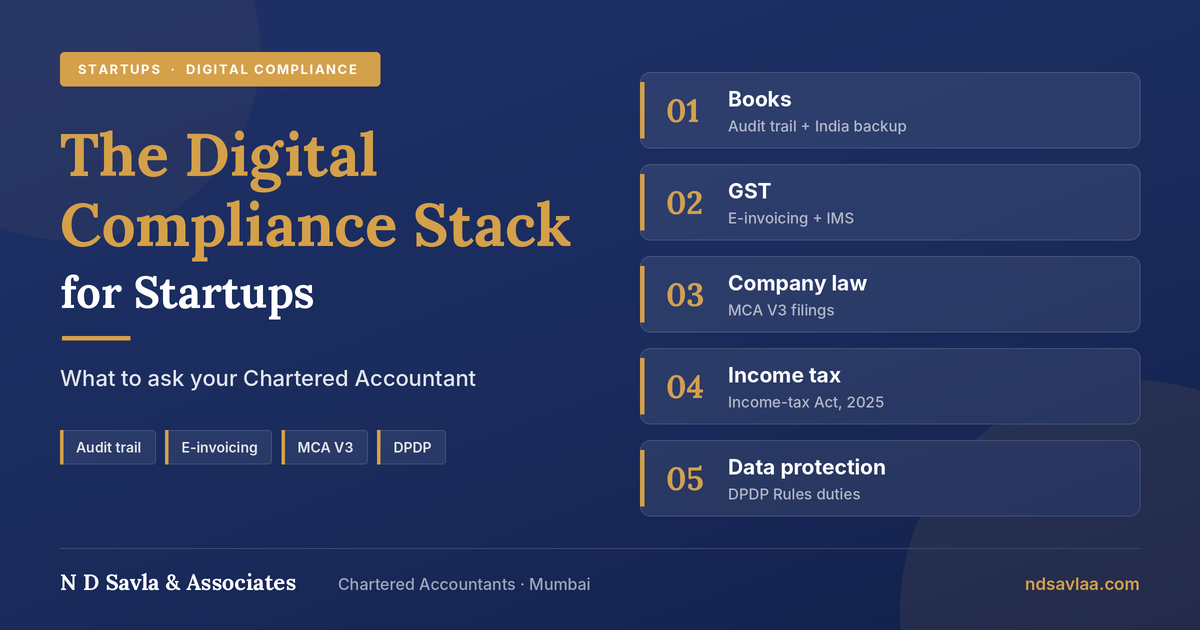
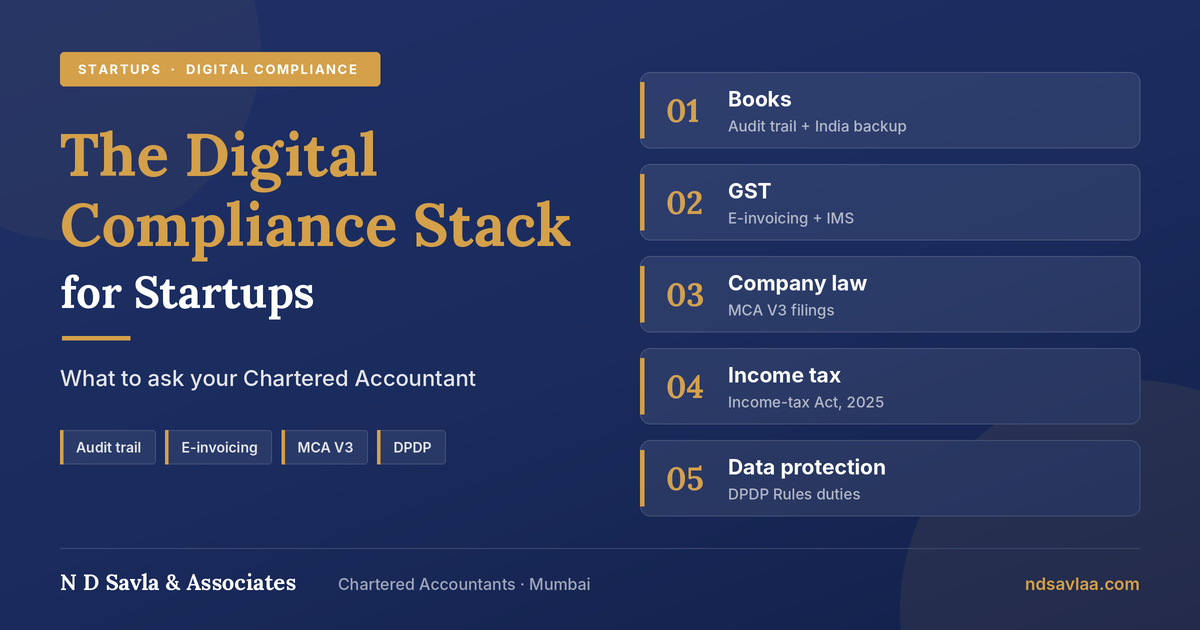
What Are the Five Layers Founders Should Understand First?
Books
Accounting software with a mandatory audit trail and daily backup on servers in India.
GST
E-invoicing above ₹5 crore turnover, 30-day reporting at ₹10 crore and above, and the Invoice Management System for input tax credit.
Company law
Filings and records through the MCA V3 portal.
Income tax
New sections, forms and codes under the Income-tax Act, 2025 from 1 April 2026.
Data protection
Duties under the DPDP Rules, phasing in to May 2027, including for data shared with advisers.
What Are the Layers of a Startup’s Compliance Stack?
| Layer | What the law or system requires | Why it matters for a startup |
|---|---|---|
| Accounting software | Audit trail and edit log that cannot be disabled (from FY 2023–24); daily backup on servers in India; cloud provider details to the ROC | Auditor reports on the audit trail; missing it is a reporting issue |
| GST invoicing | E-invoice (IRN) once turnover exceeds ₹5 crore; reporting within 30 days at ₹10 crore and above | Invoices without a valid IRN can affect buyers’ credit. See our GST compliance page |
| GST input tax credit | IMS: accept, reject or keep pending supplier invoices before credit statements | Unreviewed invoices can lead to lost or wrong credit |
| Company filings | MCA V3 portal for incorporation, annual returns and event-based forms | Late filings carry daily additional fees. See our MCA and ROC compliance page |
| Income tax and TDS | Income-tax Act, 2025 sections, forms and codes from 1 April 2026 | Payroll and TDS settings must match the new references |
| Data protection | DPDP Rules phasing in, with most duties from May 2027 | Customer and employee data, including data shared with advisers, must be protected |
Thresholds and dates change; confirm them against current notifications before relying on them.
Questions to AskWhat Should You Ask Any CA About Technology?
| Question | Why it matters |
|---|---|
| Which accounting and GST tools do you work with? | Avoids duplicate data entry and reconciliation gaps |
| How is access to our books and portals managed? | Named user accounts keep the audit trail meaningful |
| Where is our data stored, and how is it secured? | Supports Companies Act backup rules and DPDP duties |
| How do you track deadlines and notices? | GST, TDS, MCA and income-tax deadlines are frequent and penalised |
| What reports and reconciliations will we receive, and when? | Monthly GST, bank and TDS reconciliations catch errors early |
| How are certificates issued and verified? | UDIN allows certificates to be verified on the ICAI portal |
Shared logins and personal email undermine compliance. Using one shared login for accounting software, GST or MCA portals means the audit trail cannot show who changed what, and passwords outlive the people who knew them. Sending payroll or customer data by personal email or messaging apps can also breach data-protection duties. Use named, role-based accounts, secure document portals, two-factor authentication where available, and remove access promptly when people or advisers change. For the related services, see our audit and tax compliance page.
How Should a Startup Set Up Its Stack?
Choose compliant accounting software
Pick software that meets the audit trail and India backup rules, and confirm its cloud provider details for the ROC.
Set up GST invoicing and IMS
Issue e-invoices once you cross the threshold, and assign someone to act on IMS every month.
Secure your portal access
Keep MCA and income-tax logins, digital signatures and DIN details documented and secure.
Update payroll and TDS
Update payroll and TDS settings for the Income-tax Act, 2025.
Map your personal data
Map personal data you hold and share, and agree data-protection terms with service providers.
Agree a monthly close
Agree a monthly close and compliance calendar with your adviser. If you are changing advisers, use our outsourced accounting transition checklist for the handover.
Note. This article is general information based on the law and published sources as of 5 November 2026. It is not professional advice. Thresholds and dates change; confirm current requirements under the Companies Act, 2013, GST law, the Income-tax Act, 2025 and the DPDP Rules, and consult a Chartered Accountant before acting.
What Should Startups Watch Into 2027?
- Phased DPDP obligations, with most duties applying from May 2027.
- The first returns and tax audits under the Income-tax Act, 2025, filed in 2027.
- Further GST changes to IMS, e-invoicing thresholds and return locking.
- MCA portal and form changes, and any Companies Act amendments affecting startups.
- Startup recognition and incentives: see our guide to DPIIT startup recognition 2026 for eligibility and the application steps.
For queries. N D Savla & Associates, Chartered Accountants, Mumbai, advises on accounting, GST, company law and audit compliance. For questions, contact clientdesk@savlagroup.in or +91 98218 32683, or see our contact page. This article is for general information only and is not professional advice or a solicitation of work.
What Are the Most Asked Questions About Startup Digital Compliance?
Why does a startup’s compliance depend on technology now?
Most filings and records are digital by law or in practice: company books must sit in software with an audit trail, GST invoices above a turnover threshold must be registered on the e-invoice system, company filings go through the MCA V3 portal, and income-tax returns and notices are handled online. A startup’s systems and its adviser’s processes need to work together.
What is the audit trail requirement for accounting software?
From financial years beginning on or after 1 April 2023, companies using accounting software must use software that records an audit trail of each transaction and an edit log of changes, which cannot be disabled. The statutory auditor reports on it, and the trail must be kept as part of the books for eight years.
Must company books be backed up in India?
Yes. Under Rule 3(5) of the Companies (Accounts) Rules, added in August 2022, books kept in electronic form must be backed up daily on servers physically located in India, and details of any third-party or cloud provider must be given to the Registrar annually.
When does a startup need GST e-invoicing?
E-invoicing applies once aggregate annual turnover in any year from 2017–18 exceeds ₹5 crore. Businesses with turnover of ₹10 crore or more must report invoices to the e-invoice portal within 30 days of the invoice date. Confirm the current thresholds before relying on them.
What is the GST Invoice Management System?
IMS on the GST portal lets a buyer accept, reject or keep pending the invoices its suppliers upload before they flow into the input tax credit statement. Regular action in IMS and matching with the purchase register protects credit, and its rules were updated from the October 2025 tax period.
What changed for income tax in 2026?
The Income-tax Act, 2025 applies from 1 April 2026, with new section numbers, forms and codes. Software and payroll systems need updating for TDS, and FY 2025–26 returns continue under the old Act, so both sets of references are in use for a while.
How do the DPDP Rules affect a startup?
The Digital Personal Data Protection Rules were notified in November 2025 and phase in, with most obligations applying from May 2027. Startups that handle customer or employee data need consent, security safeguards and breach processes, and must make sure service providers, including their accountants, protect shared data.
What should a startup ask its CA about technology?
Which accounting and GST tools they work with; how they handle data access, storage and security; how they track deadlines and notices; whether reports and reconciliations are delivered on a fixed schedule; and how documents are shared and signed, including UDIN for certificates.
Should a startup share its accounting software login with its CA?
Use named, role-based user accounts rather than shared logins, so every change is traceable in the audit trail. Give access only to what is needed, review it periodically and remove it when the engagement ends.
Does using the latest software mean compliance is automatic?
No. Software automates calculations and reminders, but judgement is still needed on tax positions, classification, reconciliations and responses to notices. The most useful setup combines good systems with clear responsibilities and regular review.
Related Guides and Services
- DPIIT Startup Recognition 2026: eligibility, benefits and the application steps.
- Audit and Tax Compliance: compliance support for companies and firms.
- GST Compliance: indirect tax returns and reconciliations.
- MCA and ROC Compliance: company law filings and registers.
- Outsourced Accounting Transition Checklist: what to hand over when changing accountants.
- How to Choose the Right CA for Your Startup: credentials, fit, independence and terms.
Questions About Digital Compliance for Your Startup?
For general queries on accounting, GST, company law and audit compliance, contact N D Savla & Associates, Chartered Accountants, at Ashok Premises, Nicholas Road, Andheri East, Mumbai, using the details below or on our contact page.
Suite No.102, L1, Ashok Premises, Nicholas Road, Andheri East, Mumbai - 400069
Contact the Firm →This article is for general information only and is not professional advice or a solicitation of work.