The True Cost of Accounting for Small Businesses: A Cost-Mapping Framework
The True Cost of Accounting for Small Businesses: A Cost-Mapping Framework
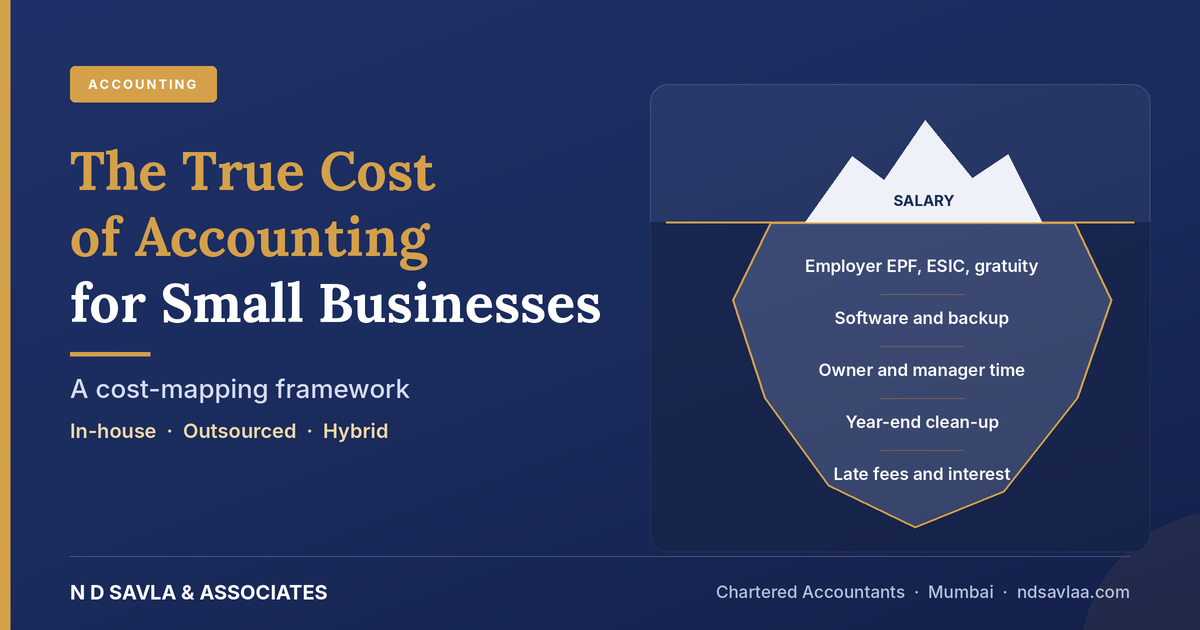
The true cost of accounting is not the salary of one accountant or the quote from one firm. It is the sum of four cost groups: people, tools, time and errors. This guide from N D Savla & Associates, Chartered Accountants, Mumbai, maps each cost line and gives a worksheet to compare in-house, outsourced and hybrid models on the same basis. Statutory figures are from published sources as of 6 November 2026.
Key Takeaways
- Compare total cost, not salary against a quote.
- Employer costs can include EPF, EDLI, ESIC, gratuity and bonus where the laws apply.
- Owner time and year-end clean-up are real costs, even if no invoice is raised.
- Late GST, TDS, income tax and ROC filings carry per-day fees and interest.
- The right model depends on volume, scope and how well documents flow, not on a rule of thumb.
What Are the Four Cost Groups in Small Business Accounting?
People
Salary plus employer statutory contributions, leave cover, recruitment and training.
Tools
Accounting software, backup, devices and audit-trail compliance.
Time
The owner’s and managers’ hours spent on review, documents and queries.
Errors
Late fees, interest, lost input tax credit and year-end clean-up.
What Goes Into the True Cost of Accounting?
| Cost group | Typical lines | Often missed |
|---|---|---|
| People | Salary, employer contributions, bonus, leave, recruitment, training | Cover during leave or after a resignation |
| Tools | Accounting software, payroll and GST tools, devices, backup | Audit-trail and backup obligations for companies |
| Time | Owner and manager review, document chasing, query handling | Opportunity cost of the owner’s hours |
| Review and year-end | Reconciliations, finalisation, audit support | Clean-up of backlogs before the audit |
| Errors | Late fees, interest, lost ITC, notices | Professional time spent responding to notices |
What Does an In-House Accountant Cost Beyond Salary?
| Cost line | What applies |
|---|---|
| EPF (employer) | 12% of wages up to the wage ceiling, where the Act applies |
| EDLI and EPF administration | 0.5% each on EPF wages, borne by the employer |
| ESIC (employer) | 3.25% of wages for employees within the ₹21,000 a month threshold |
| Gratuity | 15 days’ wages per completed year of service, where the Act applies |
| Statutory bonus | For eligible employees under the Payment of Bonus Act |
| Professional tax and labour welfare fund | As per state rules |
| Leave, recruitment and training | Cover during absence; hiring and onboarding a replacement; keeping skills current on GST and tax changes |
| Supervision | Time a partner, owner or senior manager spends reviewing the work |
Applicability depends on headcount, wages and the state. The new labour codes may change how some of these are calculated; confirm current rules before budgeting.
Hidden CostsWhat Hidden Costs Do Owners Overlook?
- Owner time: hours spent approving entries, finding bills and answering auditors are hours not spent on customers.
- Single-person risk: if one accountant leaves, the knowledge of the books often leaves too.
- Backlogs: unreconciled bank, GST and vendor accounts surface at year-end, when fixing them is slowest.
- Compliance tools: companies must keep books in software with an audit trail that cannot be disabled, retained for eight years, with daily backups on servers in India. See our guide to the digital compliance stack.
- Lost credit: input tax credit not matched to GSTR-2B in time can be lost or reversed.
What Does Getting It Wrong Cost?
| Default | Statutory cost | Note |
|---|---|---|
| Late GSTR-3B | ₹50 per day (₹20 for nil returns), capped at ₹10,000 per return | Plus 18% a year interest on tax paid late. See our GST compliance page |
| Late GSTR-9 / 9C | ₹200 per day, capped at 0.25% of state turnover | Annual return |
| Late TDS return | ₹200 per day under section 234E, up to the TDS amount | Plus 1% / 1.5% a month interest for late deduction / deposit |
| Late income tax return | Up to ₹5,000 under section 234F (₹1,000 if income up to ₹5 lakh) | Plus section 234A interest; some losses cannot be carried forward |
| Late AOC-4 / MGT-7 | Additional fee reported at ₹100 per day of delay | No upper cap reported. See our MCA and ROC compliance page |
Don’t compare a salary with a quote. A salary figure leaves out employer contributions, leave cover, software, owner time and the cost of errors, while an outside quote may exclude data entry, payroll or notice work. Before comparing, list the same scope for both: which returns, which reconciliations, who enters data, who handles notices and who supports the audit. Comparing unequal scopes is the most common reason cost estimates go wrong.
How Can You Compare In-House, Outsourced and Hybrid Models?
Fill in an annual figure for each line that applies, using your own payroll records and written proposals. Leave a line blank only if it truly does not apply. If you decide to change adviser, use our outsourced accounting transition checklist for the handover.
| Cost line | In-house | Outsourced | Hybrid |
|---|---|---|---|
| Salary and employer contributions | Full | None for accounting staff | Data-entry staff only |
| Engagement cost | None | As per written scope | Reduced scope |
| Software and backup | Business pays | Check who pays | Usually business pays |
| Leave and turnover cover | Business arranges | Covered by firm’s team | Partly |
| Owner review time | Estimate hours | Estimate hours | Estimate hours |
| Year-end clean-up and audit support | Estimate | Check if in scope | Check if in scope |
| Late fees and interest (last 2 years) | From records | From records | From records |
Questions to settle before deciding
- What is the monthly transaction volume, and how many GST registrations and bank accounts are there?
- Who will enter data, and how will documents reach the accountant?
- Which returns, reconciliations and year-end tasks are in scope, in writing?
- What did late fees, interest and notices cost in the last two years?
- How will access, data security and audit-trail obligations be handled?
For credential, fit and independence checks, see our guide on how to choose the right CA.
Note. This article is general information based on published sources as of 6 November 2026. It is not professional advice. Statutory rates, thresholds and late fees change; confirm them with the relevant authority before budgeting, and consult a Chartered Accountant about your business’s position.
What Should Small Businesses Watch Into 2027?
- Implementation of the labour codes and any change to EPF and ESIC wage ceilings.
- The first returns and audits under the Income-tax Act, 2025, filed in 2027.
- GST changes to IMS, e-invoicing and return time limits.
- MCA form and fee changes.
For queries. N D Savla & Associates, Chartered Accountants, Mumbai, advises on accounting, GST, company law and audit compliance. For questions, contact clientdesk@savlagroup.in or +91 98218 32683, or see our contact page. This article is for general information only and is not professional advice or a solicitation of work.
What Are the Most Asked Questions About the Cost of Accounting?
What is the true cost of accounting?
It is the total of everything a business spends to keep books and meet compliance: people, employer statutory contributions, software and hardware, the owner’s own time, year-end clean-up and review, and the late fees, interest and lost credits that errors cause.
Why isn’t salary a fair comparison with an outside firm’s quote?
Because salary is only one line. An employer also bears contributions such as EPF and ESIC where applicable, gratuity and bonus liabilities, leave cover, recruitment, training, software licences and supervision time. A fair comparison puts all of these against the full scope an outside engagement covers.
What statutory costs come with hiring an accountant?
Where the laws apply, employer EPF at 12% of wages up to the ceiling, EDLI and administration charges, ESIC at 3.25% for employees within the wage threshold, gratuity of 15 days’ wages per completed year, and statutory bonus for eligible employees. State professional tax and labour welfare fund rules also apply.
What hidden costs do owners overlook?
Their own time spent reviewing, chasing documents and answering queries; the cost of covering leave or a resignation; reconciliation backlogs that surface at audit; and software, backup and audit-trail obligations under the Companies (Accounts) Rules. See our digital compliance stack guide for those obligations.
How much does a late GSTR-3B cost?
A late fee of ₹50 per day (₹20 for nil returns), capped at ₹10,000 per return, plus interest at 18% a year on tax paid late. Late GSTR-1 returns attract similar per-day fees. See our GST compliance page for return support.
What does a late TDS return cost?
A fee of ₹200 per day under section 234E until the return is filed, capped at the TDS amount, plus interest of 1% a month for late deduction and 1.5% a month for late deposit.
What does a late income tax return cost?
A fee under section 234F of up to ₹5,000 (₹1,000 where total income is up to ₹5 lakh), plus interest under section 234A on unpaid tax. A late return also means some losses cannot be carried forward.
What does late ROC filing cost?
Additional fees under the Companies (Registration Offices and Fees) Rules. For annual filings such as AOC-4 and MGT-7 this is reported as ₹100 per day of delay, with no cap, and directors can face further consequences for continued default. See our MCA and ROC compliance page.
Is outsourcing always cheaper?
Not necessarily. It depends on transaction volume, how much work stays in-house, the scope agreed and how well the business supplies documents. The worksheet in this article helps compare the options on the same basis.
What is a hybrid accounting model?
A model where routine data entry stays in-house while an outside firm handles reconciliations, returns, review and year-end work. It suits businesses that want someone on site for day-to-day entries.
Related Guides and Services
- Outsourced Accounting Transition Checklist: what to hand over when changing accountants.
- The Digital Compliance Stack for Startups: books, GST, company law, income tax and data protection.
- How to Choose the Right CA for Your Startup: credentials, fit, independence and terms.
- GST Compliance: indirect tax returns and reconciliations.
- MCA and ROC Compliance: company law filings and registers.
- Audit and Tax Compliance: compliance support for companies and firms.
Questions About the Cost of Accounting for Your Business?
For general queries on accounting, GST, company law and audit compliance, contact N D Savla & Associates, Chartered Accountants, at Ashok Premises, Nicholas Road, Andheri East, Mumbai, using the details below or on our contact page.
Suite No.102, L1, Ashok Premises, Nicholas Road, Andheri East, Mumbai - 400069
Contact the Firm →This article is for general information only and is not professional advice or a solicitation of work.