The Ultimate Checklist for Transitioning to Outsourced Accounting Services
The Ultimate Checklist for Transitioning to Outsourced Accounting Services
Transition to outsourced accounting goes smoothly when it is run as a short project in six phases: scope and agreement, data handover, access and controls, compliance continuity, a parallel run and governance. The company and its board stay responsible for the books, the statutory auditor cannot keep them (section 144), and electronic books must stay accessible in India with a daily Indian back-up. This checklist from N D Savla & Associates, Chartered Accountants, Mumbai, sets out each step and is based on the law and published sources as of 3 November 2026. It pairs with our guide to in-house vs outsourced accounting, which covers whether to outsource.
Key Takeaways
- Timing: switch at the start of a month or quarter, after closing and reconciling the last period.
- Responsibility: your statutory auditor cannot keep your books (section 144); responsibility stays with the board (section 128).
- Electronic books: accessible in India, daily back-up on Indian servers, provider details reported with the financial statements.
- Controls: keep the audit trail on, give view-only bank access, and keep payment approval in-house.
- Before data moves: run at least one parallel close; put data protection and exit terms in writing.
What Does the Full Checklist Look Like?
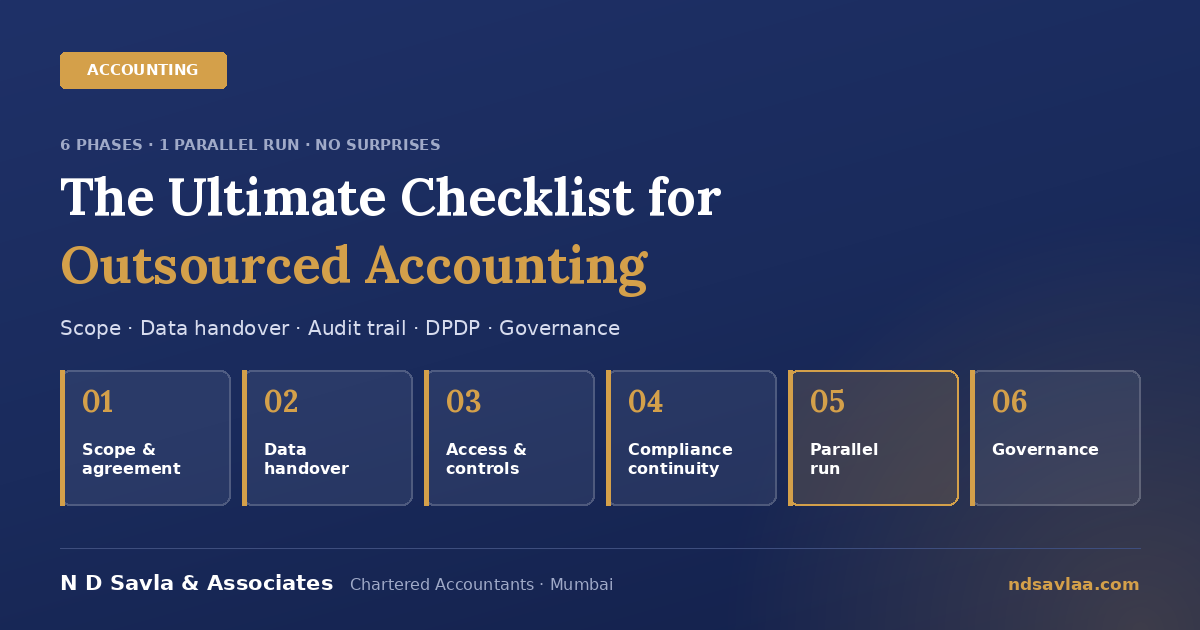
Run the move as a short project in six phases:
- Scope and agreement: Decide what moves and what stays, check the provider is not your statutory auditor, and sign an engagement letter covering deadlines, security and exit.
- Data handover: Close and reconcile the last period, then hand over ledgers, reconciliations, returns, registers and an open-issues list.
- Access and controls: Set up software users with the audit trail on, portal access and DSC custody, and view-only bank access.
- Compliance continuity: Map the next 90 days of due dates, and meet the electronic books rules (accessible in India, daily back-up in India, provider details to the Registrar).
- Parallel run: Run one close side by side and reconcile differences.
- Governance: Agree monthly close timelines, reports and reviews; the company and its board stay responsible for the books.
| Phase | Tasks | Owner |
|---|---|---|
| 1. Scope and agreement | Define services (bookkeeping, payroll, GST, TDS, ROC, MIS); confirm independence from the statutory auditor; agree deadlines, review points, data security, breach notice and exit terms in an engagement letter | Management with the provider |
| 2. Data handover | Close the last period; hand over trial balance, ledgers, bank and GST reconciliations, fixed asset register, receivable and payable ageing, payroll, TDS returns, statutory registers, key contracts and an open-issues list | Outgoing team |
| 3. Access and controls | Create named software users with roles; confirm audit trail is on; arrange GST, income-tax, TRACES, MCA, EPFO and ESIC access; agree DSC custody; set view-only bank access; keep payment approval in-house | Management and IT |
| 4. Compliance continuity | List every due date for the next 90 days; confirm who files each; check books are accessible in India with daily Indian back-up; record provider details for the Registrar | Provider with management |
| 5. Parallel run | Process one close in both teams; reconcile balances, returns and payroll; fix gaps; sign off | Both teams |
| 6. Governance | Set monthly close dates, MIS pack, KPIs, review meetings and escalation; review the arrangement quarterly | Management and board |
Owners are a guide; adjust them to your team and the engagement letter.
Before the MoveWhat Should Be Agreed Before the Move?
- Scope: list every task that moves, and every task that stays, such as payment approval, vendor onboarding and final sign-off of returns.
- Independence: under section 144 of the Companies Act, 2013, the statutory auditor cannot provide bookkeeping or accounting services to the company.
- Service levels: dates for monthly close, MIS reports and each statutory return, with time for your review.
- Data protection: the provider handles personal data of employees, customers and vendors. Agree security measures, breach notification and return or deletion of data at exit.
- Exit: how records, working files and access are handed back if the arrangement ends.
Which Data and Documents Should Be Handed Over?
- Closed books: trial balance and general ledger for the current and previous year, with opening balances agreed.
- Reconciliations: bank, GST (GSTR-1, GSTR-3B and GSTR-2B/IMS), TDS (26AS/AIS and returns), and intercompany balances. See our GST compliance page.
- Registers and schedules: fixed asset register, receivable and payable ageing, inventory records, loan schedules and prepaid and accrual workings.
- Payroll: salary structures, statutory deductions, EPF and ESIC records, and any changes made for the labour codes.
- Legal and tax: previous returns, assessments and notices, MCA filings, statutory registers and key contracts.
- Open issues: a list of unreconciled items, pending notices, disputes and upcoming deadlines.
How Should Access and Controls Be Set Up?
- Accounting software: named user IDs with roles, not shared logins. Since 1 April 2023, companies must use software with an audit trail of every change that cannot be disabled.
- Government portals: give access through proper user roles where portals allow it, and keep the main credentials and multi-factor authentication with the company. For MCA filings, see our MCA and ROC compliance page.
- Digital signatures: decide who holds each DSC and how its use is approved.
- Banking: view-only or statement access for reconciliations; payments approved by authorised people in the company, with maker-checker if the provider prepares payment files.
- Records: books kept electronically must remain accessible in India, with a daily back-up on servers physically in India (Rule 3 of the Companies (Accounts) Rules, 2014, as amended from 11 August 2022).
Outsourcing does not move responsibility. The company must keep proper books under section 128, and the board confirms this in the directors’ responsibility statement. With the financial statements, the company must tell the Registrar the service provider’s name, IP address and location, and the cloud address where books are on the cloud. Personal data handled by the provider remains the company’s responsibility as data fiduciary; under the DPDP Rules, 2025, security safeguards and 72-hour breach reporting apply from 13 May 2027. Put these points in the engagement letter before data moves.
How Do You Keep Filings on Track During the Move?
Before cut-over, list every due date for the next 90 days and name who files each one. Our audit and tax compliance page and compliance calendar help with the dates, and our Director KYC guide covers a director-level filing that is easy to miss during a handover. Confirm that the books are accessible in India with a daily Indian back-up and that provider details are recorded for the Registrar.
Parallel RunHow Do You Run the Parallel Close and Handover?
Choose a cut-over date
Pick a date, ideally the first day of a month or quarter.
Close the previous period
Let the outgoing team close the previous period and agree balances with the new provider.
Run the first month in parallel
Both teams post the same transactions and prepare returns.
Compare and investigate
Compare the trial balance, GST and TDS returns, payroll and reconciliations; investigate differences.
Document the procedures
Record procedures, chart of accounts rules and approval flows in short SOPs.
Sign off the handover
Sign off, and remove access for anyone who no longer needs it.
Note. This article is general information based on the law and published sources as of 3 November 2026. It is not professional advice. Requirements differ for companies, LLPs and other entities, and with size and listing status. Consult a Chartered Accountant or Company Secretary before changing how your books are kept.
How Should You Govern the Arrangement Afterwards?
- Monthly: a close calendar, an MIS pack (profit and loss, balance sheet, cash flow, receivables and payables) and a short review meeting.
- Statutory: a compliance tracker showing each return, its due date, who prepared it and who approved it.
- Quarterly: review service levels, open issues, access rights and data security.
- Annually: confirm provider details for the Registrar, review the engagement letter, and check that the auditor’s independence is maintained.
What Should Businesses Watch Into 2027?
- DPDP Rules: consent manager rules apply from 13 November 2026, and most data fiduciary obligations from 13 May 2027.
- Changes to MCA and GST portals that affect user roles and access.
- Income-tax Act, 2025 forms and returns from tax year 2026–27, which change working papers and schedules.
- Further guidance on audit trail reporting by auditors.
For queries. N D Savla & Associates, Chartered Accountants, Mumbai, advises on accounting, GST, company law and audit compliance. For questions, contact clientdesk@savlagroup.in or +91 98218 32683, or see our contact page. This article is for general information only and is not professional advice or a solicitation of work.
Frequently Asked Questions About Moving to Outsourced Accounting
How long does a transition to outsourced accounting take?
It depends on the size and state of the books. A small company with clean, reconciled records may move within one monthly close; a larger business with several entities or backlogs usually needs a few months, including at least one month of parallel running. To decide whether to outsource at all, see our guide to in-house vs outsourced accounting.
When is the best time to switch?
At the start of a month or quarter, after the previous period has been closed and reconciled. Avoid switching close to the year-end, the tax audit or a major GST or TDS return date, unless the new team is already familiar with the books. Our compliance calendar shows the filing dates to avoid.
Can our statutory auditor also keep our books?
No. Section 144 of the Companies Act, 2013 bars a company’s statutory auditor from providing accounting and bookkeeping services to it. A different firm, or a separate team not connected with the auditor, must keep the books.
Who is responsible for the books after outsourcing?
The company and its board. Section 128 requires the company to keep proper books, and directors confirm their responsibility in the directors’ responsibility statement in the board’s report. Outsourcing transfers the work, not the legal responsibility.
What are the rules for keeping books electronically?
Under Rule 3 of the Companies (Accounts) Rules, 2014, as amended from 11 August 2022, electronic books must be accessible in India at all times, with a daily back-up on servers physically in India. With the financial statements, the company tells the Registrar the service provider’s name, IP address and location, and the cloud address where records are on the cloud. See our MCA and ROC compliance page.
Does the audit trail rule apply to outsourced books?
Yes. Since 1 April 2023, companies must use accounting software that records an audit trail of every change, which cannot be disabled. This applies whoever operates the software, so check the provider’s setup before moving.
What about data protection when outsourcing accounting?
The accounting firm usually acts as a data processor for personal data such as employee and customer details. The DPDP Rules, 2025, notified on 13 November 2025, bring most data fiduciary obligations, including security safeguards and 72-hour breach reporting, into force from 13 May 2027. Agreements should already cover security, breach notice and data return.
Should we give the accounting firm full access to our bank accounts?
Usually not. View-only or statement access is normally enough for bookkeeping and reconciliations. Payment approval should stay with authorised people in the company, with a maker-checker process if the firm prepares payment batches.
What is a parallel run?
A period, often one monthly close, when both the old and new teams process the same transactions and compare results. Differences are investigated before the new team takes over fully.
What should the engagement letter cover?
The main points are:
- scope of services and what stays in-house
- deadlines for monthly close, returns and reports
- access, data security and confidentiality
- handling of personal data and breach notification
- fees, review meetings and escalation
- exit and handover of records if the arrangement ends
Related Guides and Services
- In-House vs Outsourced Accounting: whether to outsource: cost and control.
- Audit and Tax Compliance: compliance support for companies and firms.
- GST Compliance: indirect tax returns and reconciliations.
- MCA and ROC Compliance: company law filings and registers.
- DIR-3 KYC Guide: director compliance to track during a handover.
- Compliance Calendar: quick reference for filing dates.
Questions About Moving to Outsourced Accounting?
For general queries on accounting, GST, company law and audit compliance, contact N D Savla & Associates, Chartered Accountants, at Ashok Premises, Nicholas Road, Andheri East, Mumbai, using the details below or on our contact page.
Suite No.102, L1, Ashok Premises, Nicholas Road, Andheri East, Mumbai - 400069
Contact the Firm →This article is for general information only and is not professional advice or a solicitation of work.