Every year, millions of salaried individuals in India sit down to file their Income Tax Return — and immediately hit the same wall: “Should I file ITR-1 or ITR-2?”
It sounds simple. It isn’t. Choosing the wrong form can lead to a defective return, tax notices, or missed deductions. At N D Savla & Associates, we’ve helped thousands of clients navigate this exact confusion. This guide breaks it all down clearly — so you file right, the first time.
ITR-1, commonly called Sahaj, is the simplest income tax return form designed for resident individuals with straightforward income sources. If your financial life is relatively uncomplicated — a salary, one house, and some savings interest — ITR-1 was built for you.
You are eligible to file ITR-1 if:
ITR-1 is the most commonly filed return in India and is suitable for the majority of salaried employees whose only investments are 80C instruments like PPF, ELSS, or life insurance.
ITR-2 is for individuals and HUFs who have income that goes beyond the simple salary-plus-savings picture. Think of it as the next level — covering more complex financial situations.
You must file ITR-2 if:
If any one of the above applies to you, ITR-1 is off the table — no exceptions.
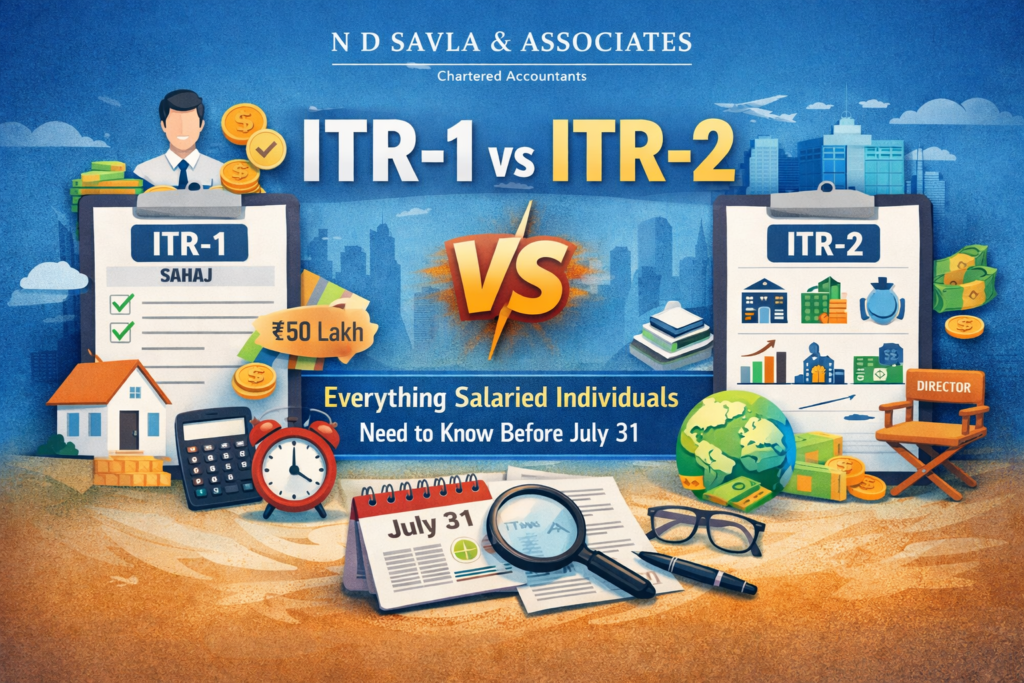
| Criteria | ITR-1 | ITR-2 |
|---|---|---|
| Salary / Pension Income | ✅ Yes | ✅ Yes |
| Income below ₹50 lakhs | ✅ Required | ❌ Not required |
| Capital Gains (stocks, MF, property) | ❌ Not applicable | ✅ Applicable |
| More than 1 house property | ❌ Not allowed | ✅ Allowed |
| NRI / RNOR status | ❌ Not allowed | ✅ Allowed |
| Foreign income / assets | ❌ Not allowed | ✅ Allowed |
| Director in a company | ❌ Not allowed | ✅ Allowed |
The due date for filing ITR for most individuals (non-audit cases) is July 31 of the assessment year. Missing this date is not just an inconvenience — it has real financial consequences.
At N D Savla & Associates, we start the ITR filing process as early as June to ensure our clients never pay a single rupee in avoidable late fees.
Filing an income tax return seems straightforward until it isn’t. Here are the most frequent — and avoidable — errors we see:
1. “My employer filed it for me” Your employer deducts TDS and issues Form 16. That’s it. Filing your ITR is entirely your responsibility.
2. “I don’t earn enough to file” Even if your income is below the taxable limit, you may still want to file to claim your TDS refund or maintain a clean financial record for loans and visa applications.
3. “My Form 16 covers everything” Form 16 only covers your salary income. Your FD interest, Zerodha or Groww capital gains, rental income, and freelance earnings all need to be separately declared.
4. “I told HR my tax regime, so I’m done” Declaring your regime to HR only affects how your employer deducts TDS during the year. The actual tax regime election — old vs new — happens at the time of filing. These are two separate choices.
5. “I’ll just copy last year’s ITR” New financial year. New income. New form changes. New budget amendments. Never copy-paste a return.
6. “I’ll file on July 31st” The Income Tax portal faces severe load on the last day every single year. File at least a week early.
7. Filing the wrong ITR form Filing ITR-1 when you should have filed ITR-2 (e.g., you had mutual fund gains) results in a defective return notice under Section 139(9), forcing you to refile.
Whether you file ITR-1 or ITR-2, gather these documents before you begin — or before you call your CA:
| Document | Why It Matters |
|---|---|
| Form 16 (Part A & B) | Complete salary and TDS summary from employer |
| Form 26AS + Annual Information Statement (AIS) | Full picture of all income and taxes paid |
| Bank statements (all accounts) | FD interest, large credits, savings interest |
| Investment proofs | 80C (LIC, PPF, ELSS), 80D (health insurance), NPS |
| Capital gains statement | From broker (Zerodha, Groww) or mutual fund houses |
| Home loan interest certificate | For Section 24 interest deduction |
| Rent receipts + landlord PAN | For HRA exemption claim |
Pro tip: Download your AIS from the Income Tax portal. It shows everything the government knows about your income — and it’s more detailed than Form 26AS.
Filing your return is only half the job. E-verification is mandatory and must be done within 30 days of filing. If you skip this step, the return is treated as if it was never filed at all.
We always recommend Aadhaar OTP. It takes 30 seconds and gives you instant confirmation.
For ITR-1 filers with simple income, the online portal is reasonably manageable. But if you have capital gains, multiple income sources, foreign assets, or are an NRI — the complexity and the stakes are high enough that professional guidance pays for itself many times over.
N D Savla & Associates offers end-to-end income tax filing services for individuals, HUFs, NRIs, and businesses. We handle everything from document collection to e-verification — and we start early so you’re never rushing on July 31.
The difference between ITR-1 and ITR-2 is not just a form number — it determines what income you declare, what deductions you claim, and whether your return is valid in the eyes of the Income Tax Department. Getting it right matters.
July 31 won’t wait. But you still have time to do this right.
If you’re unsure which form applies to you, or if you want a CA to handle your filing end-to-end, contact N D Savla & Associates today. We’ll make sure your return is filed correctly, on time, and with every deduction you’re entitled to.
N D Savla & Associates — Chartered Accountants | Mumbai Website: www.ndsavlaa.com | Income Tax Services | Contact Us