The Role of a Registered Valuer in Mergers and Acquisitions (M&A) in India
The Role of a Registered Valuer in Mergers and Acquisitions (M&A) in India
Where the Companies Act, 2013 or the Insolvency and Bankruptcy Code requires a valuation, an IBBI registered valuer must prepare it: mergers and demergers need a report on shares, property and the share exchange ratio, listed companies also need a fairness opinion, and share purchases face FEMA and income-tax pricing rules instead. This guide from N D Savla & Associates, Mumbai, explains each approval route and how to prepare. Law as understood in November 2026.
Key Takeaways
- Mergers and demergers: schemes under sections 230–232 need a registered valuer’s report on shares, property and the share exchange ratio.
- Fast-track route: since 4 September 2025, many more unlisted companies, startups and group companies can use section 233; it still needs a registered valuer’s report in Form CAA-11.
- Listed companies: they also need an independent SEBI-registered merchant banker’s fairness opinion on the valuation.
- Share purchases: they do not need a Companies Act valuation by themselves, but FEMA and income-tax pricing rules often apply.
- Preparation: good data, early appointment and consistent assumptions keep the valuation from delaying NCLT, Regional Director or stock exchange approval.
India’s deal market is busy. Grant Thornton Bharat’s Dealtracker recorded 240 M&A transactions worth about USD 27.9 billion in April–June 2026, the highest quarterly M&A value since 2022. Behind every merger, demerger and many acquisitions is a valuation that decides who gets what. In India, where that valuation is required by the Companies Act, 2013 or the Insolvency and Bankruptcy Code, it must be done by an IBBI registered valuer.
This guide explains:
- The role: what a registered valuer actually does in a deal.
- When it is required: which M&A structures legally need a registered valuer’s report.
- Each route: NCLT schemes, fast-track mergers, listed companies, cross-border deals and insolvency.
- Practical steps: how to prepare so the valuation does not hold up approval.
What Does a Registered Valuer Do in a Merger or Acquisition?
| Task | What it involves |
|---|---|
| Relative valuation | Values each company’s shares on a consistent basis and recommends the fair share exchange (swap) ratio |
| Asset and business valuation | Values businesses, undertakings or assets moving under a demerger, slump transfer or non-cash deal |
| Method selection | Applies income, market and asset approaches and explains the weight given to each |
| Independent report | Signs a report in the format required by the Valuation Rules, with disclosures on independence, scope and limits |
| Support to approvals | Answers questions from the board, audit committee, NCLT, Regional Director, stock exchanges or objectors |
The registered valuer does not decide whether the deal makes commercial sense. That is the board’s job. The valuer’s job is to give an independent, reasoned view of value that shareholders, creditors and regulators can rely on.
When It Is RequiredWhich M&A Deals Legally Need a Registered Valuer?
| Deal structure | Registered valuer needed? | Main rule |
|---|---|---|
| Merger or amalgamation through NCLT | Yes | Sections 230 and 232; valuation report sent with the notice to members and creditors |
| Demerger or transfer of undertaking through NCLT | Yes | Sections 230 and 232 |
| Fast-track merger or demerger (Regional Director) | Yes | Section 233 and Rule 25 of the CAA Rules; report filed in Form CAA-11 |
| Scheme involving a listed company | Yes, plus fairness opinion | SEBI master circular on schemes; independent merchant banker’s fairness opinion |
| Acquisition paid in new shares (share swap) | Yes, generally | Section 62(1)(c) preferential allotment for non-cash consideration |
| Buying assets from a director or connected person | Yes | Section 192 |
| Squeeze-out of minority after reaching 90% | Yes | Section 236 |
| Acquisition through an insolvency process | Yes | IBC and IBBI regulations; fair value and liquidation value |
| Cash purchase of shares from existing holders | Not under company law | FEMA (cross-border) and income-tax fair value rules may apply |
How Does Valuation Work in Each Approval Route?
NCLT schemes (sections 230–232)
The board approves the scheme after considering the registered valuer’s report. The report, or a summary, goes out with the notice to shareholders and creditors, and to regulators such as the income-tax department, RBI, SEBI or CCI where relevant. Directors must also explain the share exchange ratio and any special valuation difficulties. Objectors and the NCLT can question the valuation before the scheme is sanctioned.
Fast-track route (section 233)
The September 2025 amendment to the CAA Rules widened the fast-track route beyond small companies and wholly owned subsidiaries. It now also covers certain unlisted companies within debt limits, start-ups with small companies, group companies and demergers, subject to conditions such as an auditor’s certificate in Form CAA-10A. Approval comes from the Regional Director instead of the NCLT, but the registered valuer’s report remains part of the filing.
Listed company schemes
A listed company files the draft scheme with the stock exchange together with a registered valuer’s report on the relative fair value and share exchange ratio, and a fairness opinion from an independent SEBI-registered merchant banker. The audit committee recommends the scheme after considering both. Where an unlisted company merges into a listed one, the valuation of the unlisted company is also needed.
Cross-border mergers
For mergers between Indian and foreign companies, the CAA Rules require valuation by a valuer who is a member of a recognised professional body in the transferee company’s country, following internationally accepted principles. FEMA rules on cross-border mergers apply alongside the Companies Act.
Insolvency acquisitions
When a buyer acquires a company through the corporate insolvency resolution process, registered valuers appointed by the resolution professional estimate fair value and liquidation value. IBBI’s 2026 amendments require valuers per asset class, a methodology meeting with the committee of creditors and reports in IBBI-notified formats.
The tax side.
Valuation also matters for tax. Share transfers and slump sales are tested against fair value rules, now in the Income-tax Act, 2025 and Income-tax Rules, 2026 from 1 April 2026. These reports are often signed by a Chartered Accountant or merchant banker rather than a registered valuer, so plan which reports the deal needs at the start. Our income tax team can help map this.
How Do Valuers Arrive at a Swap Ratio?
| Approach | Typical methods | When it carries more weight |
|---|---|---|
| Income approach | Discounted cash flow (DCF) | Growing businesses with reliable projections |
| Market approach | Market price (listed shares), comparable company and transaction multiples | Listed companies and sectors with good comparables |
| Asset approach | Net asset value | Holding companies, asset-heavy businesses or loss-making entities |
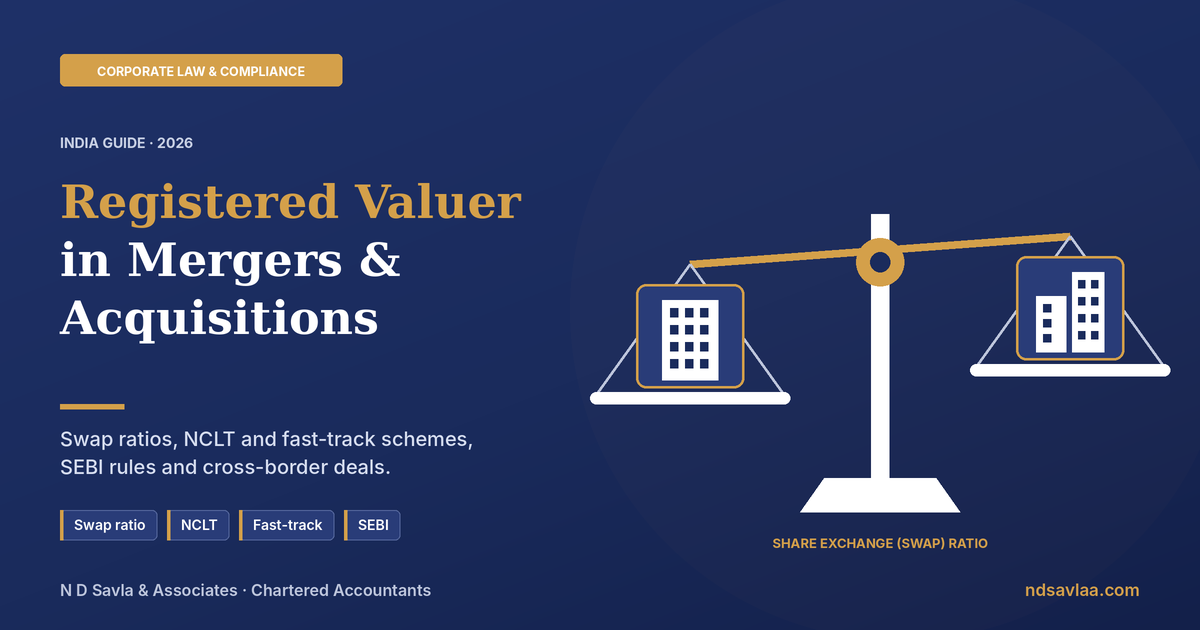
The valuer applies the same approaches and valuation date to both companies, weights the results and arrives at a value per share for each. The swap ratio is the ratio of those values, rounded and adjusted for practical share numbers. Regulators and objectors usually focus on the projections, the discount rate and the weights, so these should be clearly explained.
Common reasons valuations get questioned.
Different valuation dates for the two companies; projections that do not match the board’s own business plan; unexplained weights between methods; ignoring recent transactions or market prices; and valuers with links to promoters. Each can lead to objections, queries from the NCLT, Regional Director or stock exchange, and delay.
How Should Companies Prepare for an M&A Valuation?
Map the approvals
Decide the route (NCLT, fast-track, listed, cross-border) and list every report each law needs.
Appoint early and correctly
Have the audit committee or board appoint an independent IBBI registered valuer in the securities or financial assets class.
Fix the valuation date
Use one date for all entities and keep it close to the board meeting.
Prepare clean data
Provide audited and latest financials, projections, the shareholding pattern, material contracts and due diligence findings.
Align the documents
Keep the swap ratio and figures consistent across the scheme, directors’ report, notices and filings.
Plan for questions
Keep working papers ready for the NCLT, Regional Director, stock exchange or objectors.
For other situations, see our guides on why your startup needs an IBBI registered valuer for funding rounds and on registered valuer vs. standard CA.
Note. This article is general information based on the Companies Act, 2013, the Companies (Compromises, Arrangements and Amalgamations) Rules, 2016 as amended in September 2025, the Companies (Registered Valuers and Valuation) Rules, 2017, SEBI circulars, the IBC and IBBI regulations, FEMA and the Income-tax Act, 2025 as understood in November 2026. It is not legal or tax advice. For your own transaction, speak to a Chartered Accountant.
What Are the Most Asked Questions About Registered Valuers in M&A?
Is a registered valuer needed for every merger?
For mergers and demergers under sections 230–233 of the Companies Act, a registered valuer’s report is generally required.
What is a share exchange ratio?
The number of transferee company shares given for each share of the transferor company, based on their relative values.
Does a fast-track merger need a valuation?
Yes. The registered valuer’s report is filed with the scheme in Form CAA-11 to the Regional Director.
Who gives the fairness opinion?
For listed companies, an independent SEBI-registered merchant banker gives a fairness opinion on the valuation report.
Does a share purchase need a registered valuer?
Not under the Companies Act by itself, but FEMA and income-tax pricing rules may require a valuation report.
What about cross-border mergers?
The valuation must be done by a valuer who is a member of a recognised professional body in the transferee’s country.
Which methods do valuers use?
Usually a mix of income (DCF), market (multiples, market price) and asset approaches, with weights explained in the report.
Who appoints the valuer?
The audit committee or, where there is none, the board of directors of each company.
Can the same valuer act for both companies?
Often one valuer or a joint team prepares the relative valuation; for listed schemes, independence rules must be met.
How long does a merger valuation take?
Usually a few weeks, depending on data quality, the number of entities and the methods used.
Related Guides and Services
- Why Your Startup Needs an IBBI Registered Valuer for Funding Rounds: valuation for preferential allotments, CCPS, PAS-4 and FEMA.
- Registered Valuer vs. Standard CA: who can sign which valuation report.
- Due Diligence Support: data-room and investor due diligence packages.
- ROC and MCA Compliance: PAS-3, PAS-4 and other company law filings.
- Income Tax Services: tax planning, returns and assessments.
- Audit Services: statutory and other audits by an independent firm.
- Startup Advisory: round planning, compliance and fundraising support for startups.
- Compliance Calendar: key ROC, FEMA, GST and tax dates.
Planning a Merger, Demerger or Acquisition?
NDSA helps companies plan restructuring routes, prepare financial information and due diligence for valuers, and handle ROC and MCA compliance, FEMA reporting and income tax aspects of the deal. Book a consultation to map the reports and approvals your transaction needs.
Suite No.102, L1, Ashok Premises, Nicholas Road, Andheri East, Mumbai - 400069
Book a Consultation →This article is for general information only and is not professional advice or a solicitation of work.