Registered Valuer vs. Standard CA: When Do You Legally Need an IBBI Valuer?
Registered Valuer vs. Standard CA: When Do You Legally Need an IBBI Valuer?
A Chartered Accountant is not automatically an IBBI registered valuer: valuations required under the Companies Act, 2013 or the Insolvency and Bankruptcy Code must come from a registered valuer, while FEMA pricing certificates and many tax reports can be signed by a CA. This guide from N D Savla & Associates, Mumbai, shows when each signer is needed and how to check the signer before a report is used. Law as understood in November 2026.
Key Takeaways
- Section 247: section 247 of the Companies Act requires valuations under the Act to be done by a registered valuer, registered with IBBI.
- A CA is not automatically a valuer: a CA must pass IBBI’s exam, train through an RVO and register in the right asset class.
- When it is mandatory: registered valuer reports are needed for preferential allotments, non-cash deals with directors, mergers and schemes, minority buyouts, insolvency and liquidation.
- When a CA can sign: a CA can sign FEMA pricing certificates, many income-tax fair value reports and routine certificates.
- Verify first: always check the signer’s IBBI registration number and asset class before the report is used.
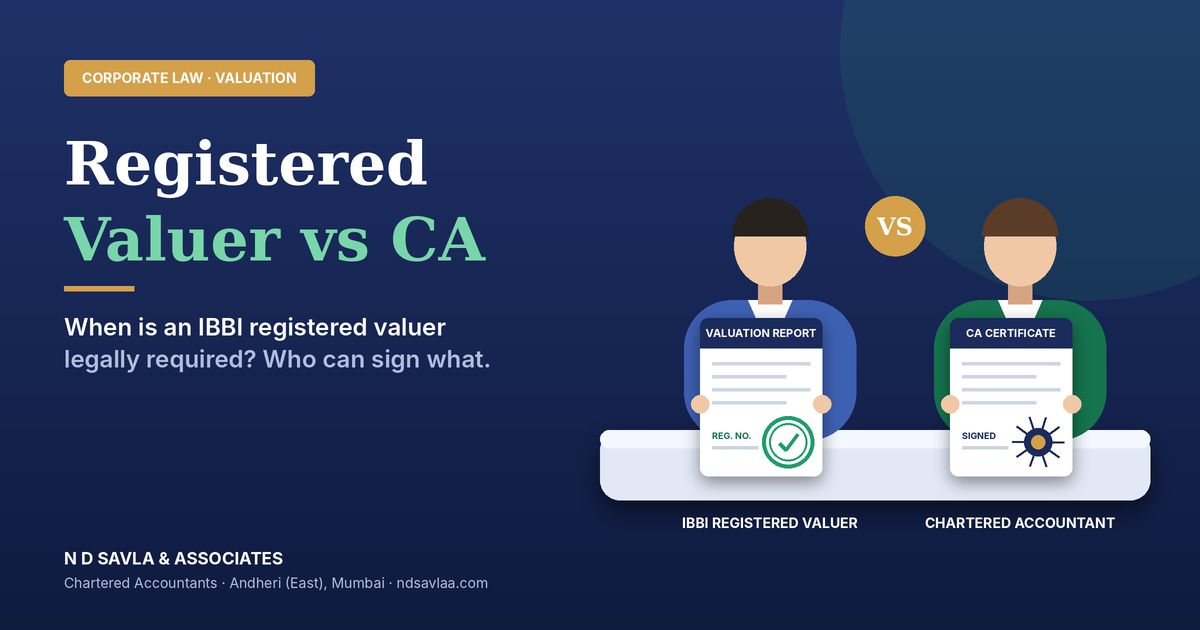
“Can our CA do the valuation?” is one of the most common questions a company asks before a share issue, merger or buyout. The honest answer is: it depends on which law needs the valuation. A Chartered Accountant can sign many valuation certificates, but where the Companies Act, 2013 or the Insolvency and Bankruptcy Code requires a valuation, it must come from an IBBI registered valuer. Using the wrong signer can delay an allotment, a scheme or a filing.
This guide explains:
- The difference: how a registered valuer differs from a standard CA.
- When it is mandatory: every common situation where the law requires a registered valuer.
- When a CA can sign: where a CA’s certificate or report is enough.
- How to get it right: how to choose and check the right signer.
Short answer: use an IBBI registered valuer, in the right asset class, wherever the Companies Act or the IBC requires a valuation, and a CA, merchant banker or cost accountant where FEMA or income-tax rules name one. Check the signer’s IBBI registration number before the report is used.
The DifferenceWhat Is the Difference Between a Registered Valuer and a Standard CA?
| Point | IBBI registered valuer | Chartered Accountant (not registered as a valuer) |
|---|---|---|
| Legal basis | Section 247, Companies Act, 2013; Companies (Registered Valuers and Valuation) Rules, 2017 | Chartered Accountants Act, 1949; ICAI membership |
| Regulator | IBBI as authority, through a registered valuer organisation (RVO) | ICAI |
| Qualification | IBBI valuation exam in an asset class, RVO training, registration and continuing education | CA qualification and certificate of practice |
| Asset classes | Land and building; plant and machinery; securities or financial assets | Not applicable |
| Can sign Companies Act and IBC valuations | Yes, within the registered asset class | No |
| Can sign FEMA and many tax reports | Only if also qualified under those laws (for example as a CA) | Yes, where the law names a CA or accountant |
Many experienced CAs are also registered valuers. The question is not whether your adviser is a CA, but whether the person signing holds the registration the law asks for. IBBI’s public register shows more than 6,000 individual registered valuers across all asset classes, so qualified signers are available in most cities, including Mumbai.
When It Is MandatoryWhen Does the Law Require an IBBI Registered Valuer?
| Event | Provision | What must be valued |
|---|---|---|
| Preferential allotment (shares, convertibles) | Section 62(1)(c) with Rule 13, Share Capital Rules | Price of the securities, and any non-cash consideration |
| Sweat equity shares | Section 54 with Rule 8, Share Capital Rules | Value of the shares and of the IP or know-how received |
| Non-cash deals with directors | Section 192 | Assets bought from or sold to a director or connected person |
| Mergers, demergers and schemes | Sections 230 and 232 | Share exchange ratio, shares and property in the scheme |
| Minority buyout (90% holders) | Section 236 | Price offered to minority shareholders |
| Company liquidation | Section 281 | Assets of the company in the liquidator’s report |
| Insolvency (CIRP) and liquidation | IBC, 2016 and IBBI regulations | Fair value and liquidation value, usually by two registered valuers per asset class |
| Voluntary liquidation | Section 59, IBC, 2016 | Assets of the company, filed with the declaration of solvency |
| Listed company preferential issues (certain cases) | SEBI ICDR Regulations | Price, where a registered valuer’s report is required |
| REITs and InvITs | SEBI REIT and InvIT Regulations | Trust assets |
Penalties under section 247.
A registered valuer who breaks the rules can be fined, and where there is intent to defraud the company or its members, can face imprisonment and a higher fine, besides refunding fees and paying damages. For the company, the bigger risk is practical: an allotment, scheme or filing built on the wrong report can be questioned by the ROC, the NCLT, investors or the tax office.
When Can a Standard CA Sign the Valuation?
| Purpose | Who can sign | Note |
|---|---|---|
| FEMA pricing for foreign investment (issue or transfer) | CA, SEBI-registered merchant banker or practising cost accountant | Fair value under an internationally accepted pricing method |
| Income-tax fair market value (many cases) | Accountant (CA) or merchant banker, depending on the rule | Under the Income-tax Rules, 2026 from 1 April 2026; check the specific rule |
| ESOP perquisite value for unlisted shares (income tax) | SEBI-registered merchant banker | Neither a CA nor a registered valuer alone qualifies |
| Net worth, turnover and similar certificates | CA in practice | For banks, tenders, visas and regulators |
| Valuations for internal decisions or negotiations | Any competent professional | No statutory signer; a registered valuer adds credibility |
| Fair values for financial statements (Ind AS) | Management, with specialist support | No statutory signer; auditors review the method |
One event, several reports.
A single transaction can trigger more than one law. For example, a preferential allotment to a foreign investor may need a registered valuer’s report under the Companies Act and a FEMA certificate, while an ESOP grant may need a merchant banker’s report for income tax. One professional who holds all the relevant registrations can sometimes cover them in coordinated reports, but each report must meet its own law’s rules on method, signer and valuation date.
How Do You Choose and Check the Right Valuer?
Identify every law involved
List the Companies Act, IBC, SEBI, FEMA and income-tax rules your transaction touches before appointing anyone.
Match the signer to each law
Use a registered valuer for Companies Act and IBC valuations, and a CA or merchant banker where FEMA or tax rules ask for one.
Check IBBI registration
Search the valuer’s name or IBBI number on the IBBI registered valuers list and confirm the asset class.
Check independence
Avoid valuers related to promoters, directors or the counterparty, and ask for a written declaration.
Appoint correctly
Have the audit committee or board appoint the registered valuer and record the terms.
Align dates and figures
Keep the valuation date, price and terms consistent across resolutions, forms and agreements.
For startups planning a fundraise, our guide on why your startup needs an IBBI registered valuer for funding rounds covers preferential allotments, CCPS, PAS-4 and FEMA in more detail.
Note. This article is general information based on the Companies Act, 2013, the Companies (Registered Valuers and Valuation) Rules, 2017 as amended in 2026, the Insolvency and Bankruptcy Code, 2016, SEBI regulations, FEMA rules and the Income-tax Act, 2025 as understood in November 2026. It is not legal or tax advice. Confirm requirements for your transaction with a professional, or speak to a Chartered Accountant.
What Are the Most Asked Questions About Registered Valuers and CAs?
Is every CA a registered valuer?
No. A CA must pass IBBI’s valuation exam, train through an RVO and register with IBBI before signing as a registered valuer.
Can a CA be a registered valuer too?
Yes. Many CAs are also registered valuers, but they sign Companies Act valuations in their registered valuer capacity.
When is a registered valuer legally required?
For valuations required by the Companies Act, 2013 and the Insolvency and Bankruptcy Code, 2016, and some SEBI rules.
Which Companies Act sections need one?
Common ones are sections 62(1)(c), 192, 230, 232, 236 and 281, plus the sweat equity and deposit rules.
When can a regular CA sign?
For FEMA pricing certificates, many income-tax fair value reports and certificates such as net worth.
What if a CA signs instead of a registered valuer?
The report may not meet the law, so allotments, filings or schemes can be questioned, delayed or rejected.
Which asset class covers shares?
“Securities or Financial Assets”. Land and buildings, and plant and machinery, are separate classes.
Who appoints the registered valuer?
The audit committee or, where there is no audit committee, the board of directors.
Can one report satisfy several laws?
Sometimes, if the signer holds every required registration and the report meets each law’s method and date rules.
How do I check a valuer’s registration?
Search the registered valuers list on the IBBI website using the valuer’s name or IBBI registration number.
Related Guides and Services
- Startup Advisory: round planning, compliance and fundraising support for startups.
- ROC and MCA Compliance: PAS-3, PAS-4 and other company law filings.
- Due Diligence Support: data-room and investor due diligence packages.
- Income Tax Services: tax planning, returns and assessments.
- Audit Services: statutory and other audits by an independent firm.
- Virtual CFO & MIS Services: monthly MIS, forecasting, investor and lender reporting.
- Fractional CFO vs. In-House CA: what finance support your growing business needs.
- Compliance Calendar: key ROC, FEMA, GST and tax dates.
Not Sure Which Valuation Your Transaction Needs?
NDSA’s team helps companies map the legal requirements for share issues, restructurings and transfers, prepare the information a valuer needs, and handle ROC and MCA compliance, FEMA reporting and income tax filings. Book a consultation to check which reports your transaction needs and who can sign them.
Suite No.102, L1, Ashok Premises, Nicholas Road, Andheri East, Mumbai - 400069
Book a Consultation →This article is for general information only and is not professional advice or a solicitation of work.