Why Your Startup Needs an IBBI Registered Valuer for Funding Rounds
Why Your Startup Needs an IBBI Registered Valuer for Funding Rounds
Angel tax is gone, but your funding round still needs the right valuation: a preferential allotment by a private company generally needs a report from an IBBI registered valuer, and foreign investment needs a separate FEMA fair-value certificate. This guide from N D Savla & Associates, Mumbai, explains when a registered valuer is required and how Companies Act, FEMA and income-tax valuations differ. Law as understood in November 2026.
Key Takeaways
- Preferential allotments: a preferential allotment of shares or convertibles by a private company generally needs a registered valuer’s report to support the price.
- Right asset class: for shares, the valuer must be registered with IBBI in the “Securities or Financial Assets” asset class.
- Angel tax is gone, rules remain: angel tax was abolished from assessment year 2025-26, but company-law and FEMA pricing rules still apply.
- Foreign investors: foreign investment needs a separate FEMA fair-value certificate from a CA, SEBI-registered merchant banker or practising cost accountant.
- Start early: the report, board and shareholder approvals, and ROC and FEMA filings all depend on the valuation.
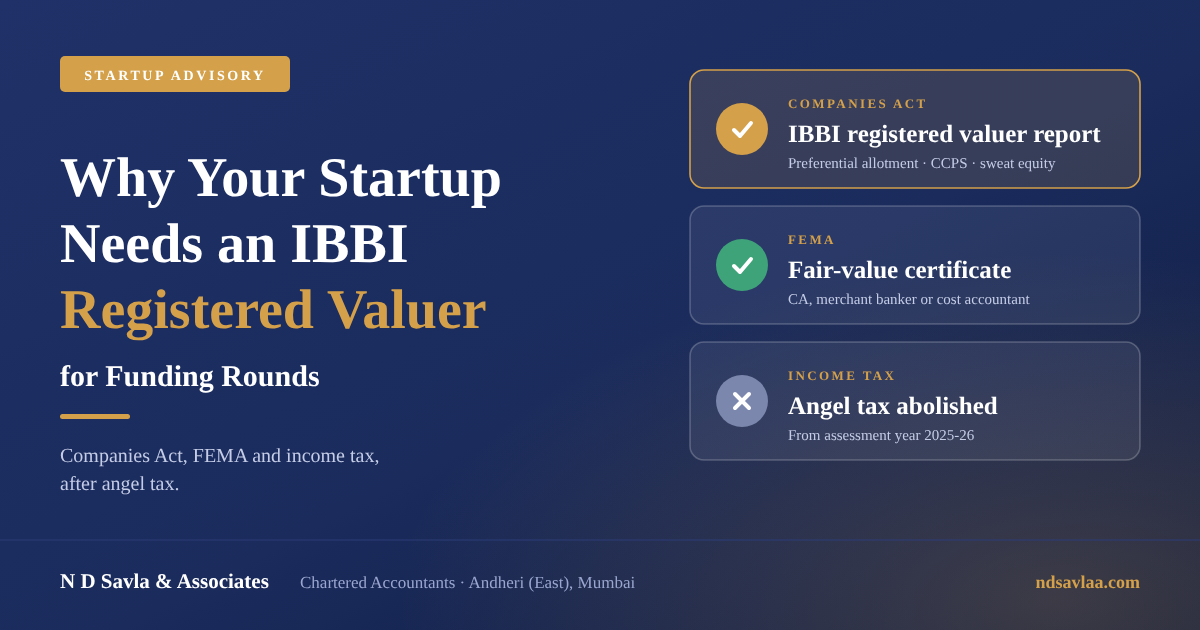
Many founders assume valuation reports stopped mattering when angel tax was abolished. They did not. When your company issues new shares or convertible instruments to an investor, the Companies Act, 2013 still sets how the price must be supported, and for most private funding rounds that means a report from an IBBI registered valuer. Get it wrong and the allotment can be challenged, filings can be rejected and investors may delay closing.
This guide explains:
- The basics: who an IBBI registered valuer is and what they can sign.
- When it is required: which funding steps need a registered valuer’s report.
- The three rulebooks: how Companies Act, FEMA and income-tax valuations differ after angel tax.
- How to prepare: a practical checklist to get the valuation right first time.
Short answer: if your company is issuing new shares or convertibles to an investor, plan on a report from an IBBI registered valuer in the “Securities or Financial Assets” class, and add a separate FEMA fair-value certificate if the investor is foreign. Angel tax no longer applies to new rounds, but these two pricing rules do.
The BasicsWho Is an IBBI Registered Valuer?
Section 247 of the Companies Act, 2013 says that where the Act requires a valuation of shares, securities, property or net worth, it must be done by a registered valuer. The Companies (Registered Valuers and Valuation) Rules, 2017 set up the system, and the Insolvency and Bankruptcy Board of India (IBBI) acts as the registration authority.
| Feature | What it means for your startup |
|---|---|
| Registration | The valuer passes IBBI’s examination, completes training through a registered valuer organisation (RVO) and is registered with IBBI |
| Asset classes | Land and building; plant and machinery; securities or financial assets. Share valuations need the securities or financial assets class |
| Appointment | Appointed by the audit committee or, where there is none, the board of directors |
| Independence | The valuer must be impartial and must disclose any interest; avoid valuers connected to founders or investors |
| Accountability | Section 247 provides fines, and imprisonment where there is intent to defraud, if a valuer breaks the rules |
| 2026 update | The 2026 amendment to the Valuation Rules (in force 5 June 2026) requires each RVO to hold paid-up capital of at least ₹25 lakh, strengthening the bodies that train and discipline valuers |
When Does a Funding Round Need a Registered Valuer?
| Funding step | Registered valuer needed? | Why |
|---|---|---|
| Preferential allotment of equity to a new investor | Yes, generally | Section 62(1)(c) and Rule 13 of the Share Capital Rules require the price to be supported by a registered valuer’s report for unlisted companies |
| Compulsorily convertible preference shares (CCPS) or debentures (CCDs) | Yes, generally | The conversion price or formula is fixed at issue, based on a registered valuer’s report |
| Private placement offer (Form PAS-4) | Usually | The offer letter must state the basis of the price, along with the registered valuer’s report |
| Shares issued for non-cash consideration (for example IP or a business) | Yes | The non-cash consideration must be valued by a registered valuer |
| Sweat equity shares to founders or employees | Yes | The Sweat Equity rules require valuation by a registered valuer |
| Rights issue to existing shareholders | Usually not | Shares go to existing holders in proportion; check if rights are renounced to outsiders |
| Secondary transfer between shareholders | Not under company law | But tax and FEMA pricing may apply to the buyer and seller |
Common mistake: using the wrong report.
A FEMA valuation certificate or an income-tax fair market value report does not automatically meet the Companies Act requirement. If your round has a foreign investor, you may need two reports (or one professional who holds both registrations and writes a report that satisfies both). Confirm this before you sign the engagement letter, not after the board meeting.
What Changed After Angel Tax Was Abolished?
| Rulebook | Before | Now (November 2026) |
|---|---|---|
| Income tax (angel tax) | Section 56(2)(viib) taxed share premium above fair market value; startups used Rule 11UA valuations to defend the price | Abolished from assessment year 2025-26 by the Finance (No. 2) Act, 2024, and not carried into the Income-tax Act, 2025 |
| Income tax (other rules) | Cash-credit scrutiny of share capital (section 68); fair value rules in Rule 11UA | Proof of investor identity, creditworthiness and genuineness still needed; fair value rules now in the Income-tax Rules, 2026 (Rule 57) from 1 April 2026 |
| Companies Act | Registered valuer report for preferential allotment | No change; still required |
| FEMA (foreign investors) | Issue price not below fair value under an internationally accepted pricing method | No change; certified by a CA, SEBI-registered merchant banker or practising cost accountant |
In short, the tax risk on the premium has gone for new rounds, but the legal duty to price shares properly has not. A sound valuation also helps in later events, such as ESOP grants, secondary sales, down rounds and exits, and in any older-year tax assessments still open under the 1961 Act.
The MethodsHow Do Valuers Value an Early-Stage Startup?
| Method | Best suited to | What the valuer looks at |
|---|---|---|
| Discounted cash flow (DCF) | Startups with credible revenue projections | Business plan, growth assumptions, margins and a risk-adjusted discount rate |
| Recent transaction / price of recent investment | Follow-on rounds soon after an earlier round | Price and terms of recent arm’s-length investments, adjusted for changes since |
| Comparable companies and transactions | Sectors with listed peers or known deals | Revenue or user multiples from similar companies, adjusted for stage and size |
| Net asset value | Asset-heavy or very early companies | Book or fair value of assets less liabilities |
Most valuers use more than one method and explain why they chose the final value. Investors and regulators look for consistency between the valuation, the business plan in the pitch deck and the terms in the share subscription agreement.
The ChecklistHow Should Founders Prepare for a Smooth Valuation?
Start early
Engage the valuer as soon as the term sheet is close to final, so the report is ready before the board meeting.
Check the registration
Confirm the valuer’s IBBI registration number and that it covers securities or financial assets.
Share complete data
Provide audited and latest financials, projections, the cap table, term sheet, instrument terms and details of earlier rounds. A Virtual CFO & MIS service can help build reliable projections.
Align the documents
Make sure the price in the valuation, the shareholder resolution, PAS-4 and the agreements match.
Plan FEMA reporting
For foreign investors, arrange the fair-value certificate and file Form FC-GPR on time after allotment; add the deadlines to your compliance calendar.
Keep a valuation file
Retain reports, assumptions, investor KYC and fund-flow proof for future due diligence and tax queries.
Note. This article is general information based on the Companies Act, 2013, the Companies (Registered Valuers and Valuation) Rules, 2017, FEMA rules and the Income-tax Act, 2025 as understood in November 2026. It is not legal or tax advice. Requirements depend on your company type, instrument and investors; take professional advice before issuing shares, or speak to a Chartered Accountant.
What Are the Most Asked Questions About Registered Valuers for Startups?
What is an IBBI registered valuer?
A valuer registered with the Insolvency and Bankruptcy Board of India under section 247 of the Companies Act, 2013, through a registered valuer organisation.
Which asset class covers startup shares?
The "Securities or Financial Assets" class. Check that your valuer holds registration in this class.
When does a startup need one?
Mainly for a preferential allotment of shares or convertibles, and for sweat equity or shares issued for non-cash consideration.
Is angel tax still a concern?
No for new rounds. Angel tax under section 56(2)(viib) was abolished from assessment year 2025-26 and not carried into the Income-tax Act, 2025.
Then why get a valuation at all?
Company law and FEMA still set pricing rules, investors expect a defensible price, and the tax office can still question the source of funds.
Who values shares for a foreign investor?
Under FEMA, a Chartered Accountant, SEBI-registered merchant banker or practising cost accountant certifies the fair value.
Can one report cover both?
Often, if one professional holds the required registrations and the report meets both sets of rules. Confirm this before you engage.
Do I need a valuer for a rights issue?
Not usually, because shares go to existing shareholders in proportion. Check the facts if the issue is renounced or priced unusually.
What does a valuer need from us?
Financial statements, projections, cap table, term sheet, instrument terms and details of recent rounds.
Can NDSA help with our funding round?
Yes. NDSA helps with round planning, valuation readiness, Companies Act and ROC filings and FEMA reporting.
Related Guides and Services
- Startup Advisory: round planning, compliance and fundraising support for startups.
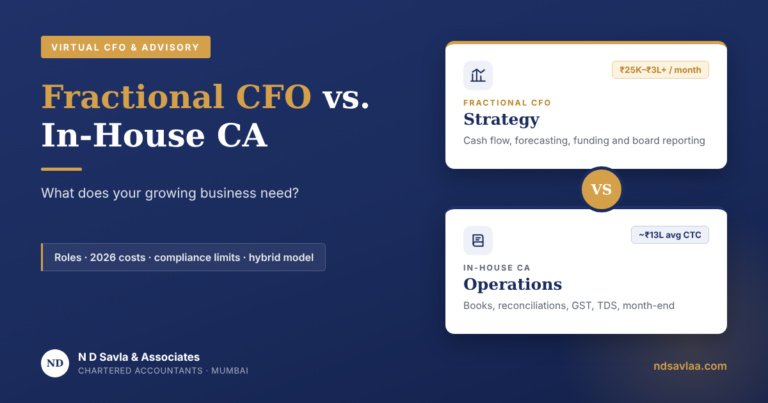
- Fractional CFO vs. In-House CA: what finance support your growing business needs.
- Virtual CFO & MIS Services: monthly MIS, forecasting, investor and lender reporting.
- ROC and MCA Compliance: PAS-3, PAS-4 and other company law filings.
- Due Diligence Support: data-room and investor due diligence packages.
- Income Tax Services: tax planning, returns and assessments.
- Audit Services: statutory and other audits by an independent firm.
- Compliance Calendar: key ROC, FEMA, GST and tax dates.
Planning a Funding Round?
NDSA’s startup advisory team helps founders plan the round, prepare the information a registered valuer needs, and handle ROC and MCA compliance and FEMA filings. Book a consultation to check which valuation reports your round needs.
Suite No.102, L1, Ashok Premises, Nicholas Road, Andheri East, Mumbai - 400069
Book a Consultation →This article is for general information only and is not professional advice or a solicitation of work.