Fractional CFO vs. In-House CA: What Does Your Growing Business Need?
Fractional CFO vs. In-House CA: What Does Your Growing Business Need?
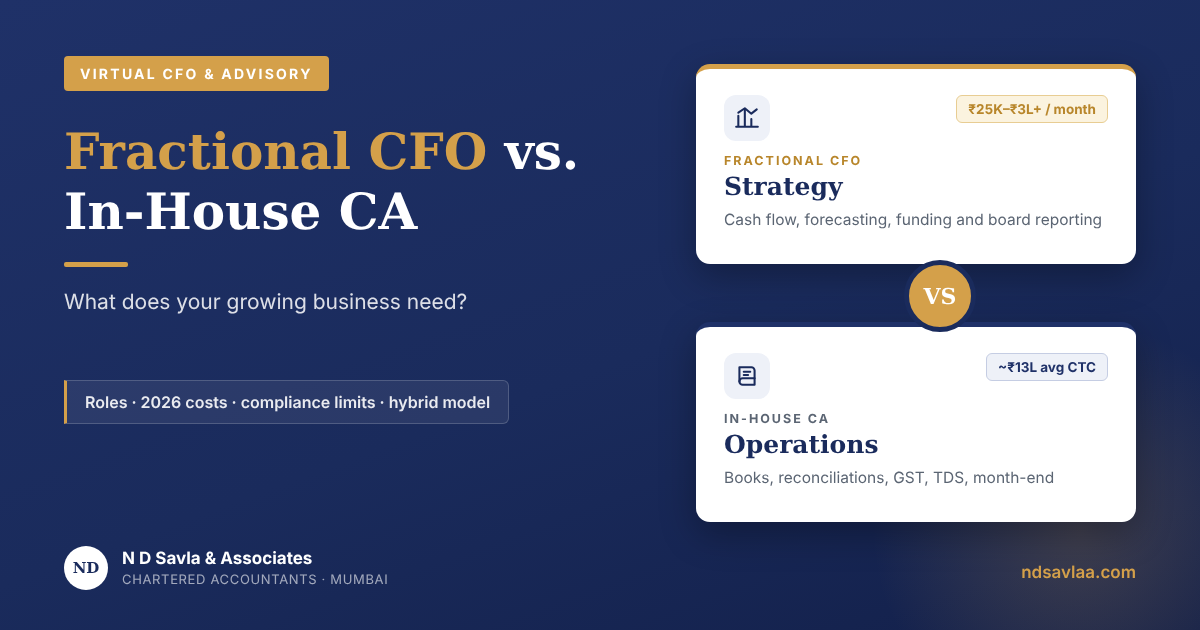
A fractional CFO and an in-house CA do very different jobs: the CA keeps your books accurate and your filings on time, while the fractional CFO plans cash, funding and growth. This guide from N D Savla & Associates, Mumbai, compares roles, 2026 costs, compliance limits and timing. Figures are market ranges from public sources as of November 2026.
Key Takeaways
- Different jobs: an in-house CA runs accounts and compliance; a fractional CFO runs financial strategy, forecasting and reporting.
- The cost of a CA hire: a newly qualified CA averaged about ₹13 lakh CTC at ICAI’s April–May 2026 campus drive, before benefits and overheads.
- The cost of a fractional CFO: retainers in India range roughly from ₹25,000 to ₹3 lakh or more a month, depending on stage and scope.
- Two legal limits: an in-house CA can never be your statutory auditor, and listed or larger public companies must appoint a whole-time CFO.
- The common answer is both: many growing businesses combine an in-house accountant or CA with a fractional CFO and an independent audit firm.

Every growing business reaches the point where the founder can no longer run the numbers alone. The usual next step is to hire a Chartered Accountant. But a newer option keeps coming up in board meetings and investor calls: a fractional CFO.
The two are not substitutes. An in-house CA keeps your books accurate and your filings on time. A fractional CFO uses those numbers to plan cash, funding and growth. The right answer depends on your size, stage and what is going wrong today. If you are a startup rather than an SME, our earlier post on why Mumbai startups are shifting to outsourced CFO services covers that stage in more detail.
Short answer: if your problem is late filings and messy books, hire or outsource accounting first. If your problem is cash planning, investor reporting or fundraising, you need CFO-level support, such as our Virtual CFO & MIS service. Most businesses between ₹2 crore and ₹50 crore revenue get the best value from both, in a mix.
The DifferenceWhat Is the Difference Between a Fractional CFO and an In-House CA?
| Fractional CFO | In-house CA | |
|---|---|---|
| Main focus | Strategy: cash flow, forecasting, funding, unit economics, board reporting | Operations: books, reconciliations, GST, TDS, income tax, month-end close |
| Time commitment | Part-time, on a monthly retainer | Full-time employee |
| Typical experience | Senior finance leader or CA-led team that has handled many companies | Ranges from newly qualified to experienced; depends on the hire |
| Cost | Monthly retainer, scaled to scope | Annual salary plus PF, gratuity, benefits, software and training |
| Looks | Forward: what to do next | Backward and present: what happened and what is due |
| Flexibility | Scale up for a fundraise, scale down after | Fixed cost; hiring and exits take time |
| Best for | Businesses needing CFO judgement but not full-time | Businesses with enough daily transactions to fill a full-time role |
What Does a Fractional CFO Do?
A fractional CFO, also called a virtual or outsourced CFO, does the strategic work of a Chief Financial Officer for a few days a month. Typical responsibilities include:
- Monthly MIS, budget vs actual reports and management commentary. See our monthly MIS and budgeting service.
- Cash flow forecasting and runway planning
- Financial models, investor reporting and fundraising support
- Bank and lender relationships, including limit renewals and stock statements
- Pricing, margin and unit-economics analysis
- Oversight of tax and compliance, so nothing is missed between teams
What Does an In-House CA Do?
An in-house Chartered Accountant is an employee who owns the day-to-day finance function. Typical responsibilities include:
- Bookkeeping, ledger scrutiny and bank, vendor and customer reconciliations
- GST returns, TDS deductions and returns, advance tax and income tax workings
- Month-end and year-end closing, and support for the statutory audit
- Payroll inputs, expense controls and internal approvals
- Coordination with auditors, tax consultants and banks
Some experienced CAs also cover planning and reporting. But a newly qualified CA is usually hired to run the engine, not to set the route.
The CostWhat Does Each Option Cost in 2026?
| Option | Typical cost | What to add on top |
|---|---|---|
| In-house CA (newly qualified) | About ₹13 lakh average CTC (ICAI campus, April–May 2026); highest domestic offers ₹27–32 lakh | Employer PF and gratuity, leave, laptop and software, training, and time spent hiring |
| Fractional CFO | Roughly ₹25,000 to ₹3 lakh or more a month, depending on stage and scope | Usually nothing; scope changes are priced in the retainer |
| Full-time CFO | Commonly quoted at ₹30–80 lakh a year | ESOPs, bonus and benefits; a long senior hiring search |
| Hybrid (accountant + fractional CFO) | Accountant salary plus a smaller CFO retainer | Clear split of tasks between the two |
Since the new Labour Codes took effect on 21 November 2025, basic pay plus dearness allowance must be at least half of total pay, which raises PF and gratuity costs for many salaried roles. Factor that into the true cost of any in-house hire, and see our payroll management service if your CTC structures need a redesign.
Two compliance limits to know.
Your in-house CA cannot be your statutory auditor. Under Section 141 of the Companies Act, 2013, an employee of the company is not eligible for appointment as its auditor. The statutory audit must be done by an independent CA firm.
A fractional CFO is not enough once the law requires a whole-time CFO. Under Section 203 and the related rules, every listed company and every other public company with paid-up share capital of ₹10 crore or more must appoint whole-time key managerial personnel, including a CFO. Your ROC and MCA compliance should track this threshold.
Which One Does Your Business Need?
| Your situation | Best fit | Why |
|---|---|---|
| Early stage, low transaction volume (see our startup advisory) | Outsourced accounting and tax compliance | Not enough daily work for a full-time CA; a firm covers filings at lower cost |
| ₹2–50 crore revenue, growing team | In-house accountant or CA plus a fractional CFO | Daily work needs an in-house owner; planning and reporting need CFO judgement |
| Raising funds or renewing bank limits | Fractional CFO now | Models, MIS and due diligence packs need senior input on a deadline |
| High transaction volume, few strategic needs | In-house CA | A full-time owner of accounts and compliance pays for itself |
| Listed, or public with ₹10 crore+ paid-up capital | Whole-time CFO (mandatory), with advisers as needed | The Companies Act requires a whole-time CFO as key managerial personnel |
What Is the Hybrid Model?
For most growing SMEs, the best answer is not either-or. A common structure is:
- Daily engine: an in-house accountant or CA handles daily entries, reconciliations and filings.
- Strategy layer: a fractional CFO reviews the numbers monthly, builds forecasts and reports to the board, investors and banks.
- Independent check: an independent CA firm audits the accounts each year.
This gives you CFO-level decisions at a fraction of a full-time CFO’s cost, while keeping someone close to the books every day.
The SignsWhat Are the Signs You Need CFO-Level Support?
- You plan to raise funds or take a large loan in the next 6–12 months
- Monthly numbers arrive late, or don’t match what the bank and investors were told
- The founder still builds the financial model and cash forecast
- Revenue has passed about ₹2 crore, or the team has grown past 20 people
- You received a tax notice you did not see coming, or you keep missing dates on your compliance calendar
- Margins are falling and nobody can explain why
What Should You Ask Before You Decide?
What problem are we solving?
Compliance gaps call for accounting help; planning and funding gaps call for a CFO.
How many transactions do we process?
High volume favours an in-house owner of the books.
What deadlines are coming?
A fundraise, audit or bank renewal favours bringing in a CFO early.
Who checks the checker?
Make sure accounts are reviewed by someone senior and audited independently.
What will it really cost?
Compare full employment cost, not just salary, with a retainer’s fixed scope.
How Can N D Savla & Associates Help?
N D Savla & Associates is an ICAI-registered Chartered Accountant firm headquartered in Andheri (East), Mumbai, practising since 2010. Depending on what your business needs, NDSA can support:
- Virtual CFO & MIS: monthly MIS, budgeting, cash flow forecasting, investor and lender reporting, delivered by Chartered Accountants on a monthly retainer.
- Accounting and tax compliance: bookkeeping, GST, TDS and income tax compliance, if you are not ready for an in-house hire.
- Payroll management: payroll processing and structuring under the new Labour Codes.
- Audit: statutory and other audits, as an independent firm.
- Due diligence support: financial due diligence packs for fundraising and transactions.
Note. Salary, retainer and CFO cost figures are market ranges from public sources as of November 2026 and vary by city, experience and scope. Legal requirements are summarised in general terms; check the Companies Act, 2013 and its rules, or speak to a Chartered Accountant, for your company’s specific position.
What Are the Most Asked Questions About Fractional CFOs and In-House CAs?
What is a fractional CFO?
A senior finance leader who works for your business part-time or on a monthly retainer, handling strategy, forecasting, reporting and funding.
What does an in-house CA do?
A Chartered Accountant on your payroll who runs day-to-day accounts, tax filings, reconciliations and month-end closing.
Which costs more?
A newly qualified CA averaged about ₹13 lakh CTC at ICAI's 2026 campus drive; fractional CFO retainers start lower and scale with scope.
Can an in-house CA act as my CFO?
Sometimes, if they have strategy, funding and leadership experience. Most early-career CAs focus on accounts and compliance.
Can my in-house CA audit my accounts?
No. Under the Companies Act, 2013, an employee cannot be the company's statutory auditor.
When should I hire a fractional CFO?
Before a fundraise or bank limit renewal, or when revenue passes about ₹2 crore and reporting starts to slip.
When must a company have a full-time CFO?
Listed companies and public companies with paid-up capital of ₹10 crore or more must appoint a whole-time CFO.
Can I use both together?
Yes. Many SMEs pair an in-house accountant or CA for daily work with a fractional CFO for strategy and reporting.
Is fractional CFO the same as virtual CFO?
Yes. Fractional, virtual and outsourced CFO all describe part-time CFO support on a retainer.
Does NDSA offer virtual CFO services?
Yes. NDSA's Virtual CFO & MIS service is delivered by Chartered Accountants on a monthly retainer based on scope.
Related Guides and Services
- Virtual CFO & MIS Services: monthly MIS, forecasting, investor and lender reporting.
- Why Mumbai Startups Are Shifting to Outsourced CFO Services: the startup-stage view of the same decision.
- MIS and Budgeting Services: monthly MIS packs, budgets and variance reports.
- Accounting and Tax Compliance: bookkeeping, GST, TDS and income tax.
- Payroll Management: payroll processing and restructuring under the new labour codes.
- Audit Services: statutory and other audits by an independent firm.
- Due Diligence Support: data-room and investor due diligence packages.
- ROC and MCA Compliance: company law filings and KMP requirements.
Not Sure Which Model Fits Your Business?
Book a free consultation with NDSA’s Virtual CFO team. We’ll review your current accounts, reporting and compliance, and recommend whether you need accounting support, a fractional CFO, or both. Start with our Virtual CFO & MIS service.
Suite No.102, L1, Ashok Premises, Nicholas Road, Andheri East, Mumbai - 400069
Book a Free Consultation →This article is for general information only and is not professional advice or a solicitation of work.