Why Mumbai Startups Are Shifting to Outsourced CFO Services in 2026
Why Mumbai Startups Are Shifting to Outsourced CFO Services in 2026
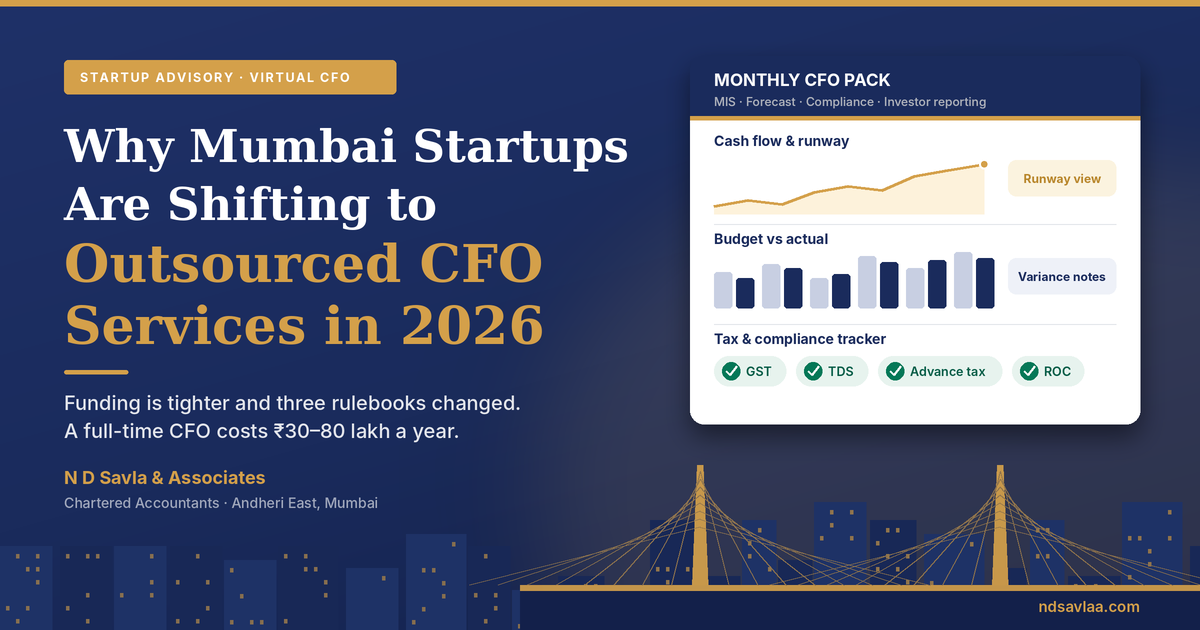
More Mumbai startups are moving to outsourced CFO services in 2026: they get CFO-level forecasting, investor reporting and compliance oversight from a Chartered Accountant team on a monthly retainer, without adding a ₹30–80 lakh salary to their burn. This guide from N D Savla & Associates, Mumbai, explains why, what you should get each month and how to choose a partner. Figures are from published sources as of 7 November 2026.
Key Takeaways
- Funding is tighter: Mumbai startups raised $587 million across 60 deals in H1 2026, down 31% year on year, so investors want sharper numbers before they write cheques.
- Three rulebooks changed within twelve months: GST 2.0 (22 September 2025), the four Labour Codes (21 November 2025) and the Income-tax Act, 2025 (1 April 2026).
- A full-time CFO in India is commonly quoted at ₹30–80 lakh a year. An outsourced CFO gives an early-stage company the core outputs at a fraction of that cost.
- Timing matters: bring one in before a fundraise, a bank limit renewal or your first big compliance miss, not after it.

Ask a Mumbai founder what kept them up last quarter, and the answer is rarely the product. It’s the runway number they weren’t sure of, the investor asking for a cohort-wise burn report, the bank wanting a stock statement by Friday, or the payroll that suddenly cost more after the new labour codes. These are CFO problems. But for most seed to Series A startups, a full-time CFO isn’t affordable or even necessary yet.
The shift comes down to five reasons:
- Investors want investor-grade numbers as funding tightens.
- Three major rulebooks changed within twelve months.
- A full-time CFO doesn’t fit an early-stage burn rate.
- More startups are competing for the same finance talent.
- Banks and lenders now expect regular MIS.
What Does an Outsourced CFO Actually Do?
An outsourced CFO (also called a virtual or fractional CFO) is a senior finance professional or team that does the strategic work of a Chief Financial Officer on a part-time or retainer basis. It sits between your bookkeeper and your board:
- A bookkeeper records what happened: entries, reconciliations, invoices. See our bookkeeping service.
- An outsourced CFO explains what it means and what to do next: cash runway, unit economics, budget vs actual, pricing, funding readiness and upcoming compliance risks.
- A full-time CFO does the same strategic work in-house, every day. That makes sense once the company is large and complex enough to keep one person fully occupied.
For most Mumbai startups between pre-seed and Series A, the middle option covers what they actually need.
The Five ReasonsWhy Are Mumbai Startups Making the Shift in 2026?
1. Investors want investor-grade numbers before they commit
Mumbai remains one of India’s top three startup funding hubs. Startups in the city raised $2.1 billion across 146 deals in 2025. But the pace has slowed: H1 2026 brought $587 million across 60 deals, a 31% drop year on year. When capital is scarcer, due diligence gets deeper. Founders need a clean monthly MIS, a defensible financial model (backed by a business valuation where a round is being priced), a burn and runway view, and data-room-ready financial statements. An outsourced CFO builds these as a routine, not as a scramble two weeks before a term sheet.
2. Three major rulebooks changed in twelve months
| Change | Effective from | What it means for finance |
|---|---|---|
| GST 2.0 rate changes: main slabs of 5% and 18%, plus 40% for demerit goods | 22 September 2025 | Re-check HSN/SAC rates, pricing, invoicing and input tax credit |
| Four Labour Codes replace 29 central labour laws | 21 November 2025 | Basic pay plus DA must be at least 50% of pay, so PF and gratuity costs rise. CTC structures need redesign: see payroll restructuring under the new labour codes |
| Income-tax Act, 2025 replaces the 1961 Act | 1 April 2026 | Tax Year replaces previous year/assessment year. New section numbers, TDS mapping and forms. First returns under the new Act are due in 2027 |
Each change hits pricing, payroll cost, cash flow and filings at the same time. That’s the cross-functional view a CFO brings and a bookkeeper usually doesn’t. There’s also good news to plan around: the startup tax holiday now covers eligible companies incorporated before 1 April 2030. For the compliance side of these changes, see our guide to GST & ROC compliance.
3. A full-time CFO doesn’t fit an early-stage burn rate
Experienced CFOs in India are commonly quoted at ₹30 lakh to ₹80 lakh a year, before ESOPs and benefits. For a startup burning, say, ₹40 lakh a month, that’s a significant cut of runway for a role needed a few days a month at this stage. Market retainers for outsourced CFOs in India range roughly from ₹25,000 a month for pre-revenue companies to ₹3 lakh or more for later-stage, multi-entity work. You pay for the output you need, not for idle hours.
4. More startups are competing for the same finance talent
India recognised a record 55,200 new startups in FY 2025–26, taking the total to over 2.23 lakh DPIIT-recognised startups as of 31 March 2026. Maharashtra leads every state with over 38,000. Every one of those companies eventually needs finance leadership, and the pool of startup-experienced CFOs in Mumbai hasn’t grown at the same pace. An outsourced team gives you that experience now, without a long hiring search.
5. Banks and lenders now expect regular MIS
Working-capital lines, venture debt and loan renewals come with reporting requirements: stock and debtor statements, projected financials and covenant tracking. An outsourced CFO keeps lender reporting on the same monthly calendar as investor and board reporting, so all three tell the same story.
The ComparisonOutsourced CFO vs In-House CFO: What Actually Changes?
| In-house CFO | Outsourced CFO | |
|---|---|---|
| Cost | ₹30–80 lakh a year, plus ESOPs and benefits | Monthly retainer scaled to stage and scope |
| Time to start | A senior hiring search, often several months | Can start with your next monthly close |
| Breadth of experience | One person’s background | A CA-led team that has seen many sectors and funding rounds |
| Compliance coverage | Depends on the hire | GST, TDS, income tax, labour code and ROC handled together |
| Flexibility | Fixed cost, hard to scale down | Scale up for a fundraise, scale down after |
| Best for | Post-Series B, multi-entity, IPO-track companies | Pre-seed to Series A/B startups and growing SMEs |
Outsourcing the CFO role doesn’t outsource accountability. Directors remain responsible for the company’s books, filings and tax positions under the Companies Act and income-tax law. Pick a partner who documents its work, shares monthly reports on fixed dates and flags risks in writing, so the board can act on them.
What Should You Get Every Month?
- Monthly financial statements and MIS within an agreed number of days after month-end. See our monthly MIS packs and budgets.
- Budget vs actual variance report with commentary on what moved and why.
- Cash flow forecast and runway view, updated every month.
- Tax and compliance tracker covering GST, TDS, advance tax and income tax.
- Investor and board pack: key metrics, financial summary and risks.
- Bank and lender reporting: stock and debtor statements, loan renewal and enhancement documents.
- Fundraising support when needed: financial model, investor-deck financials and a due diligence package.
When Is the Right Time to Bring In an Outsourced CFO?
- You’re planning to raise in the next 6–12 months.
- The founder is still the one building the financial model at midnight.
- Monthly numbers arrive late or don’t match what the bank and investors were told.
- You’ve crossed ₹2 crore in revenue or hired your 20th employee.
- You received a GST or income tax notice you didn’t see coming.
- You’re renewing or enhancing a bank limit.
How Do You Choose an Outsourced CFO Partner in Mumbai?
Chartered Accountant-led
Startup finance and tax compliance are inseparable in India.
Startup experience
Ask which funding stages and sectors they’ve supported.
Clear deliverables and timelines
Get a written list of what you’ll receive each month and by when.
Compliance under one roof
GST, TDS, payroll, ROC and income tax should feed the same MIS.
Local presence
In-person reviews in Mumbai help during fundraises, audits and bank meetings.
Why Do Mumbai Startups Choose NDSA for Outsourced CFO Services?
N D Savla & Associates has been practising as an ICAI-registered Chartered Accountant firm since 2010. Its team of 75+ serves 7,500+ clients and keeps a 98% year-on-year client retention rate. It is headquartered in Andheri East, Mumbai, with 8 offices including South Mumbai, Navi Mumbai, Pune, Goa, Hyderabad and Bengaluru, and works with startups digitally across India.
NDSA’s Virtual CFO & MIS service is built for funded startups, SMEs, family businesses formalising their reporting, and companies preparing for a PE investment, loan enhancement or other transaction. It includes:
- Monthly and quarterly financial statements with management review discussions
- Budgets, forecasts, budget-vs-actual reporting and cash flow forecasting
- GST, TDS, advance tax and income tax compliance, with tax-efficient structuring
- Bank and lender reporting, including credit-limit renewals and stock and debtor statements
- Financial models, investor-deck financials and due diligence packages
- Delivered by qualified Chartered Accountants on a monthly retainer based on your scope and business size
Note. This article is general information based on published sources as of 7 November 2026. It is not tax, legal or investment advice for your specific business. Figures such as funding totals, salary ranges and retainer ranges change over time; speak to a Chartered Accountant before acting on them.
What Are the Most Asked Questions About Outsourced CFO Services?
What does an outsourced CFO do for a startup?
An outsourced CFO handles the strategic finance work: monthly MIS, budgeting, cash flow and runway forecasting, investor and board reporting, fundraising models and compliance oversight. Day-to-day bookkeeping is usually handled separately, by your team or the same firm.
Is an outsourced CFO the same as a virtual CFO?
Yes. Outsourced, virtual and fractional CFO describe the same model: senior finance leadership on a part-time or retainer basis instead of a full-time hire. Virtual mainly refers to remote delivery, though Mumbai firms like NDSA also meet clients in person.
How much do outsourced CFO services cost in India?
It depends on transaction volume, number of entities and scope. Market retainers range roughly from ₹25,000 a month for early-stage companies to ₹3 lakh or more for complex, later-stage work. NDSA scopes its monthly retainer to your business size after a free consultation.
When should a startup hire an outsourced CFO?
Ideally 6–12 months before a fundraise, or as soon as reporting starts slipping. Other common triggers are crossing ₹2 crore in revenue, a bank limit renewal, or a first tax notice.
Can an outsourced CFO help with fundraising?
Yes. Typical support includes the financial model, the financial section of the investor deck, a data-room-ready set of financial statements, and responses to investor due diligence questions.
How does the Income-tax Act, 2025 affect startups?
From 1 April 2026, the Tax Year concept replaces previous year and assessment year, and section numbers, TDS provisions and forms are renumbered. Policy is largely unchanged, but tax planning, TDS mapping and accounting systems need updating. Eligible startups incorporated before 1 April 2030 can still claim the startup tax holiday.
Will we lose control of our finances?
No. You keep ownership of your books, bank accounts and decisions. The outsourced CFO prepares the analysis and recommendations, and founders and the board decide.
Related Guides and Services
- Virtual CFO & MIS Services: monthly MIS, forecasting, investor and lender reporting.
- MIS and Budgeting Services: monthly MIS packs, budgets and variance reports.
- Bookkeeping: day-to-day entries and reconciliations.
- Payroll Management: payroll processing and restructuring under the new labour codes.
- Due Diligence Support: data-room and investor due diligence packages.
- Startup India Services: DPIIT recognition and the startup tax holiday.
- Valuation Services: business valuation by a registered valuer.
- Outsourced Accounting, GST & ROC Compliance: how outsourced accounting covers GST and ROC filings.
Talk to NDSA’s Virtual CFO Team
If your next fundraise, bank renewal or board meeting depends on numbers you don’t fully trust yet, an outsourced CFO is the fastest way to fix that. With the Income-tax Act, 2025 now in force, this year is a good time to reset your finance function. Book a free consultation, and we’ll review your current reporting and compliance position and recommend the right scope for your stage.
Suite No.102, L1, Ashok Premises, Nicholas Road, Andheri East, Mumbai - 400069
Book a Consultation →This article is for general information only and is not professional advice or a solicitation of work.